IF TAROT’S QUEEN OF WANDS WERE YOUR WRITING COACH, she would be your enthusiastic champion, your star-spangled cheerleader! She’d laud your literary talent and encourage you to hold to your creative vision, even when others question it. You see, she believes your pen is your magic wand—that it brings to life the imaginative worlds that live inside you.
An independent sort herself, the Queen of Wands would advocate for your independence. She’s not a joiner, so she wouldn’t necessarily suggest you find yourself a critique group. But she’s a hard worker and would expect you to be one, too. In her no-nonsense style, she’d tell you dig in—and maybe hand you a bullet-point list like this one to show you exactly what she means:
Read widely in your genre—especially books that have been published in the last three years.
Subscribe to writing magazines like THE WRITER and WRITER’S DIGEST that have their finger on the pulse of publishing.
Check out blogs and YouTube videos that feature literary agents weighing in on what makes a book attractive to them and what doesn’t.
Take classes—online (Gotham Writers has a good reputation) or at your local community college, no matter. Just open your heart to how others approach the craft. Then, take what you like and leave the rest.
Create a writing schedule—and stick to it.
Finish a draft, then get a good reader to review it (you might hire a pro, ask the smartiest smarty pants in your book group to take a look, or trade for pet-sitting with a neighbor who talks regularly and intelligently about the books she reads).
And after you’ve done all that, the Queen would give you a high five, pat you on the back, and tell you, in her heartiest voice, to go back now and revise, revise, revise.
TWICE A YEAR, the yoga studio where I practice offers a “yoga challenge.” The challenge invites folks to participate in 26 classes in 30 days. WHAT?!?!?No freakin’ way! I mean, I take three classes a week. Isn’t that challenge enough?!
Maybe. But it’s been cold just lately, so instead of walking a few days a week, I’ve been bundling up and catching a daily yoga class. As of this writing, I’ve taken seven classes in seven days. And, weirdly, something’s changed. For the better. I’m predictably looser, but I’m also calmer and sleeping better. And now that I’m in the habit, it doesn’t even feel like that big a deal! So, guess what? I signed up for the February challenge.
Interestingly, my newly-engaged daily writing habit has had a similarly positive effect. Since I’ve started writing just fifteen minutes each morning, I begin each day a little more centered, a little clearer—and I also find that all my other writing tasks (hello, blog post!) flow more easily, too.
So, while I don’t expect to see you flying through your sun salutations on the mat beside me this month, I do have a special challenge for your writing self: write every day from February 1st through March 1st (or any thirty-day period you choose)!
Maybe you could start a journaling practice, setting aside twenty minutes each day to get your thoughts and heart on the page.
Or perhaps you’ve been slow-walking a book-length project—memoir, how-to book, short-story collection. See this as a chance to reinvigorate that project! Take it out for lunch. Ask it how it’s doing … Spending quality time with a project on a daily basis is a great way to remember why you started it in the first place!
Or it could be that your blog is languishing! When was the last time you posted something fresh? If you take this challenge, your answer could be: TODAY!
Wherever your writing life could use a boost, give it a daily dose of vitamin P (for practice) for thirty days. After all, as yoga grandfather Pattabhi Jois, says, “Practice, and all is coming.” And he’s not just talking about yoga.
Here’s our list (and below that, if you’re a list-aholic—or just looking for more reading recommendations—you’ll find links to three more lists to help satisfy your reading itch).
Reading (and writing) inspiration
(Okay. There are more than 20 novels on this list. Mostly, because while Jill and I agreed on many authors, we almost always chose a different book from their oeuvre. But also because there are just so many books … and we got excited.)
Then, pick the last line of a different published novel, poem, essay, recipe or _____ (fill in the blank), that’s not necessarily in the same genre as the first line.
For instance:
… and wake up to ourselves, nourished and surprised.
Finally, using the published (or found) first line as your first line, and the published (or found) last line as your last line, write your way from first line to last line, taking as many lines as you need to incorporate the ending in a way that makes (some) meaning of the journey from first to last.
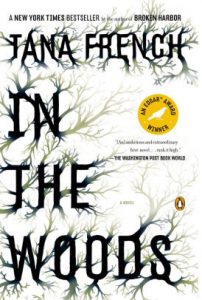
JILL AND I MEET EVERY SUNDAY TO WALK, talk books and life, and watch something on TV. Lately, our book chat and viewing choice have coincided as we’ve watched—and discussed—DUBLIN MURDERS. This eight-episode series is based on two Tana French mysteries: IN THE WOODS and THE LIKENESS.
Both books have powerful, intricate plots. So we were interested to see that screenwriter Sarah Phelps’s television adaptation has dovetailed their plot lines—creating a single interwoven narrative of the two stand-alone mysteries.
The novels (spoiler alert!)
IN THE WOODS: When Detective Rob Ryan was a kid, he and two of his friends went into the woods near their home in Knocknaree, Ireland, to play—but only Rob came out, and he remembers nothing of what happened that day. Author French flings wide a door on the possibility that the mysterious disappearance of the two other children had a supernatural cause. Certainly, the incident continues to haunt Rob twenty years later, its long shadow creating an enticingly spooky atmosphere for the present investigation, the murder of young Katy Devlin, whose body was found in those same woods.
Rob and his partner, Detective Cassie Maddox, are assigned the case, giving Rob the opportunity to reopen inquiries into the still-unsolved disappearance of his childhood friends. But what only Cassie knows is that Rob—who was once called Adam Ryan—is the same kid who emerged, alone, physically unharmed but profoundly disturbed, from the Knocknaree woods in 1984.
Having hidden his identity for twenty years, Rob is confident no one will associate him with young Adam. This identity sleight of hand is important because, if anyone besides Cassie knew who he was, Rob would be thrown off the case—and now that he’s back in the woods, Rob is not going to rest until he finds out what happened to his friends, and to Katy Devlin, and whether the tragedies are connected.
THE LIKENESS: French’s second novel, THE LIKENESS, picks up some months after IN THE WOODS ends. Although Rob is mentioned here, he is no longer a relevant character; it’s Cassie’s story entirely. While an unlikely coincidence pulls the trigger on this story, there is no hint of the uncanny in the book—only a healthy dose of psychological drama. Hoping to tease out her doppelgänger’s killer, it is Cassie, now undercover for “Operation Mirror,” who is playing cat and mouse with her identity.
The screenplay (spoiler alert!)
DUBLIN MURDERS: As I mentioned, for the TV production, the plots from these two novels have been twisted together to make a single story. This has been accomplished in several ways. Among them is the anticipated construction of a roadway, which originally threatened just the titular forest of IN THE WOODS, but now also touches the manor house at the center of the action in THE LIKENESS.
Also, in the DUBLIN MURDERS script, the plot from THE LIKENESS has been twisted to create a follow-up to a tragic childhood accident for Cassie—one that’s scarred her psyche every bit as much as Rob’s mysterious experience in the woods has scarred his. But while in the original telling of IN THE WOODS Rob’s backstory is as deeply entwined with the current-day tale as the vines winding among the trees of the Knocknaree woods, neither IN THE WOODS nor THE LIKENESS includes much of Cassie’s backstory at all. From them, we discover little about her that predates her time as an undercover officer, just prior to her partnership with Rob on the Dublin Murder Squad.
But, like author French does with the disappearance of Rob’s young friends, screenwriter Phelps imbues the tragedy in Cassie’s childhood with more than a hint of the supernatural—developing both a parallel to Rob’s mysterious backstory and giving the heretofore no-nonsense Cassie as tangled a personality as Rob’s by doing so.
With this addition, Phelps inflates an issue of identity confusion that’s at the foundation of THE LIKENESS’S murder investigation. In the TV version, when Rob’s and Cassie’s stories diverge, and Cassie leaves Rob alone with the investigation of the Knocknaree murder to go undercover on Operation Mirror, that now-sensationalized thread colors Cassie’s experiences, quite lividly.
Sensational? Or sensationalized?
Jill and I agree that DUBLIN MURDERS is a dynamic, suspenseful—often pulse-raising—adaptation. It was exciting to find ourselves in the midst of unfamiliar narrative territory, rather than just watching a stylish retelling of books we know so well. But for me, this retelling feels over-hyped, relying as it does on Cassie’s manufactured—gratuitous—response to an early tragedy. (In this opinion, Jill and I are not in absolute agreement.)
As much as the series titillated me as a viewer, as a reader, I leave it feeling overstimulated, as if I’ve eaten an entire fluffy cone of hot-pink cotton candy and now there’s too much sugar racing through my brain. (I’m planning an early 2020 re-read of THE LIKENESS to settle myself back down!)
Books vs. movie adaptations
When I discussed my concerns about DUBLIN MURDERS with ghostwriter/freelance editor pal Tom Wallace, he said, Reading a book is more active, and watching a movie or TV show is more passive. Books demand you be engaged. You’re doing some work, making more of a contribution to the story. When you read fiction, you have to use your imagination, bring something to the characters, the setting. This develops more intellectual muscle [than watching films], the ability and inclination to invest real thought and imagination.
Tom also mentioned the compression of story common in movie adaptations, citing Michael Chabon’s novel WONDER BOYS for example, saying, Reading the book is a much richer experience. If you read the book first, when you’re watching the film, you get to spots where you think, “It’s thin right there,” because the screenwriter [Steve Kloves] has had to connect two important plot issues with a very thin line. They’re under a time constraint. Everything has to fit into 120 minutes. Because the screenwriter doesn’t have time to fully develop the threads between plot points, those spots can feel thin. But when you read Chabon, nothing feels thin; he doesn’t write anything he’s not going to write in a rich way.
(Interestingly, where Tom finds Chabon “rich,” Jill finds him dense and says she connected more to Kloves’s WONDER BOYS adaptation than to the novel.)
Episodic
I’m glad to say DUBLIN MURDERS doesn’t suffer from this sort of compression. Too often, though, while film adaptations may be true to the events of the book, they end up feeling episodic—quick-juxtaposing one important scene after the next. Although they may hit every plot point, as Tom says, they tend to do so without creating enough space, enough context for those points to unfold organically. Instead, transitions from beat to beat may feel abrupt, making for a fractured, staccato delivery of the story.
(Jill, on the other hand, loves the 2011 version of JANE EYRE and credits screenwriter Moira Buffini with creating both a beautiful translation of the almost 200-year-old book and one that makes the story accessible to a contemporary audience. Also, while Jill did feel rushed by the WOLF HALL miniseries, the authority with which actor Mark Rylance brings to life historical figure Thomas Cromwell made watching WOLF HALL not only a worthwhile experience for her, but, she says, an awesome one!)
Back to Dublin
But let’s return to DUBLIN MURDERS, which, as I said, doesn’t suffer from Oliver Twist syndrome. Still, watching the show as a writer, editor, and lifelong reader, I found myself wondering about this adaptation business. For instance,
What does Tana French think of the screenplay? And other authors whose books have been rewritten for the screen? How do they feel about the adaptations of their work?
Does preparing a book for the screen necessitate significant tightening, tweaking, and manipulation? Is that simply a function of adaptation? Or is such treatment a reflection of our heightened, hyperbolic times?
How often are the often contrived screen versions of novels all that most people remember of the original books? And if they are, is that a loss of some kind? Or does it just preserve the work for our fast-paced world?
And the big question
Is the book always better than the movie?
I think it may be. And so does Tom. At least most of the time. And Rick Riordan, author of PERCY JACKSON AND THE OLYMPIANS, among many other books for younger readers, agrees. In a post on his site titled “Books to Movies,“ Riordan, who is famously unhappy with the adaptations made of two of his novels, writes,
…. very few books … are turned into decent movie versions … [T]he vast majority are dreadful adaptations…. Still, hope springs eternal…. despite the fact that I have never walked out of the cinema and said, “Wow, the movie was so much better than the book!”
Jill, though? She says, “If screenwriters are mining the story in a new way for the their medium, I’m all for that.” And she found a 2013 FLAVORWIREarticle titled “10 Authors Who Loved the Film Adaptations of Their Books” to back up her contention that at least some authors are happy with how the movie version of their work turned out!)
But despite our differences of opinion, Jill and I are proving Riordan right in one thing: Regarding book-to-film adaptation, hope does seem to spring eternal—demonstrated in this case by the Jill’s and my mutual very high hopes for Greta Gerwig’s new version of Louisa May Alcott’sLITTLE WOMEN!
* * *
Thanks to writer friend Teri Anpowi Saveliff for sending me looking to Rick Riordan for his thoughts on film adaptations!
On the longest night of the year, my mom and I strolled softly lit paths through the wooded grounds of the Central Florida Zoo during the Asian Lantern Festival—and I’m so glad I preserved this precious experience as a “snapshot memoir.” As we wandered, we encountered illuminated lanterns shaped like crescent moons and meerkats and life-sized hippotamuses—and, yes, tigers. Oh, my!
Now that she’s 85, I treasure sharing quiet adventures like this with my mom. So I took pictures—lots of them. Of the tigers and cheetahs and dragon lanterns, yes. But also of my mom. Because these are moments I’ll want to remember, and the pictures will help me do so. But I know I can drop even deeper into those moments by writing about the photos that capture them.
In a blog post titled “Why Do We Write? A New Year’s Exploration,” I quick-list a dozen reasons I write and help others write (and in the post, I invite you to explore your reasons for writing, too!). While I somehow forgot to include “preserving memories” on that list, doing so is one of the wonderful gifts writing gives to us.
I’m not alone in thinking this. Natalie Goldberg says writers live twice: first in their immediate experiences and second in writing about them. Of course, if we have photos of our experiences, we have the opportunity to home in on details we might have forgotten otherwise. And vice versa: When we write from photographs of our lives, we tend to discover what’s hidden beneath a photo’s surface.
Snapshot memoirs
A sub-genre dedicated to writing from our pictured memories, in the snapshot memoir (also known as flash memoir), we may be writing from actual images—on our phones or in our photo albums—or from indelible snapshots in our mind’s eye. Either way, though flash memoir is different from flash fiction—because we focus on our own lives rather than on the created lives of imagined others—many of the rules of flash fiction apply to this super-short snapshot memoir form, too.
Setting aside just ten minutes with pen in hand and a photo in front of you, travel back to the moment the snapshot has captured in its frame. Allow yourself to enter the picture. Look around carefully. Now, peek outside the frame to your memory of the wider context. What’s going on to the left of the image? To the right? Who’s taking the photo? Why?
You might take a deep breath and dive into the emotions the image evokes—both the sweet feelings and the bittersweet. Or maybe the photo calls to mind associated memories that add to the meaning and magic of that particular instant in time.
However deep you’re ready to delve, imagine the photo as a treasure map. It’s full of possibilities for sure! But to access the gold it promises, we need to follow the path the map reveals. When we write about the image before us, sentence by sentence, we step steadily toward riches the photo can only hint at. Because the real treasure lives inside us. And our pen creates the road that will take us there.
DAYS SPEED BY, BUT WRITING GOES SLOW. It’s in its nature. We pre-write, draft, redraft, review, revise, edit, and proofread—just to get 500 decent words where we want them. Instead of railing against the constraints time puts on our writing process, we can choose to drop below time’s dictates and give ourselves an opportunity to move at the pace of writing, rather than demanding our writing perform at the hectic pace of life.
To that end, here are twelve gifts to give to your writerly self this coming year. You might want to unwrap one a month between now and next December. May each of these exercises nourish your writing needs and give your creative self a chance to breathe.
1. Visit a used bookstore. Browse dusty shelves for treasure. Settle on the floor in the picture book aisle and allow your inner kid to journey through the illustrated worlds you find there.
2. Journal. Curl up on the couch one Sunday morning and write with no agenda, no goal. Take this time to discover what you think, what you feel, what you mourn, what you hope for … all by writing it down.
3. Discover a new-to-you author. Ask writing pals to recommend writers they think you’d enjoy. Check out the new releases section of your local library. Or read THENEW YORK TIMES Book Review, join a book group, or sign up for Goodreads. Let other writers share their gift with you this year.
4. Start a manageable new writing project. Perhaps you’ve always wanted to create a kids’ book about a favorite toy. Or compile your grandmother’s recipes, updated to make the most of today’s kitchen gadgetry. Or collect photographs of your cats, caption the images, and produce a few copies just for you and your cat-crazy friends (or is that just me?). A new project can add fuel to your writing life. Just make sure it’s the right size to bring to completion this year. Because writing “The End” on a draft is a sweet reward for a (small) job well done.
5. Make a date with a writing pal. A cup of coffee, a croissant, and congenial company create the perfect ambiance for a few quick, free-writing sessions. (I’ve got about a zillion writing prompts on my blog that you’re welcome to use for this purpose! Just search “prompts.”)
6. Take a walk. While you’re strolling, keep an eye out for interesting sights and occurrences. Maybe snap a few pictures along the way. When you get home, take just ten minutes to write about what you saw.
7. Record your dreams. Keep a notebook by your bed and jot details from your dreams a few mornings in a row. This lets your unconscious know you’re listening, making it more likely that it will offer up the fresh goods next time you need access to its wild, imaginative leaps.
8. Nap. Or, if you’re not a napper, steal an hour out of an otherwise busy day for horizontal couch time. Flick through a magazine (check out THE SUN MAGAZINE!), or read a short story or personal essay. Snuggling with an available cat, optional.
10. Follow your nose. You know how sometimes you’re online looking for one thing and something else catches your eye? And reading about that next thing, you see something even more intriguing? Great! Indulge that! Follow your nose from interest to interest, filling the thirsty well of your mind with tidbits that may come in handy in some future writing project—or may not. Even if you never use any of that cool stuff, I bet your writing self considers the time well spent. (Brain Pickings is a great place to start your nose-following quest!)
11. Earmark November. Each November, writers around the world take on the NaNoWriMo challenge. Short for “National Novel Writing Month,” NaNoWriMo provides support to get bigger projects done. While the NaNo official goal is 50,000 words on the first draft of a new novel, you might piggyback on NaNoWriMo’s energetic community to complete a more modest project—a short story, for instance, or one of those manageable projects you started back at number 4!
12. Throw your writer self a party. Pull out all the writing you’ve created this year and celebrate the sheer number of words you got on the page. Raise a glass, bake a cake, fling confetti. You’ve done good. Congratulations!
* * *
Marina Shemesh has released this “Balanced Stones On White Background” image under Public Domain license CC0 Public Domain.I appreciate the opportunity to use it here.
I TOOK IMPROVISATIONAL ACTING CLASSES FOR A COUPLE OF YEARS. This exercise is the perhaps unorthodox child of those experiences and my crazy love of a complicated writing prompt. Here’s how I offered it in a writing workshop, once upon a time …
Writing prompt
With Six You Get Egg Roll Start by describing a vacant setting. One character enters—with justification. (Why did your character come “on stage”? What are they after? Add some internals to let your reader know.)
After a bit, a second character joins the first—also with justification. Characters One and Two interact. Then Character Three joins the cast. All three play their roles, until Number Four, and then Five, enter in turn. (Add a Number Six, and you win the egg roll!)
Five Fingers on My Hand The trick? All your characters enter with reasonable justification, each has an agenda, and your drama engages them all: Think, mini-scenes, embroilment, cross-talk, cross-purposes, competition.
Count Down
Then, for equally good reasons, in reverse order of their entrances, each character leaves the scene until your setting is once again an empty stage.
Harold and Maude Improv actors will recognize this exercise as a Harold, a classic improv device. Writers will recognize this exercise as a neat trick that forces them out of the box of two- or even three-character scenes. Past Monday night workshoppers will recognize this as a fresh pat of butter used to sizzle the creative (vegan) bacon of their agile brains.
What do you think?
Five? Six? Seven? How many characters can you get on and off the stage of your story while still holding tight to the belt loop that suspends your reader’s disbelief?
As you can see in the image above, five characters are engaged in a confrontation of some sort. The Five of Wands typically represents a hotly contested competition, a chaotic bid for power between factions, opposing voices or ideas, or a flair-up of conflicting goals.
Whether it’s a family drama, a bar brawl, or a political debate gone bad, it’s never pleasant to find ourselves smack in the middle of such a real-life clash of energy. However, if your fictional characters start acting out like this, you’re in luck!
So, while you probably don’t want to court such struggle in your day-to-day relationships, when you’re writing fiction, slap a version of the Five of Wands up on your inspiration board as a reminder to let your major characters knock each other around with big (metaphoric) sticks … until the dust settles and a winner emerges from the fray.
WRITING CAN LIFT US TO FLIGHTS OF FANCY or, like a draft mule, it can pull the plow of practicality from one end of the field to the other. Here, we explore the mule end of the spectrum, with what’s called a “process essay.”
The process essay (which you might remember from your Comp 1 class) offers step-by-step directions to guide a reader through a task. Sure, it’s more about treading the well-tilled field of communication than lifting off into the wild blue of fantasy. But it can be a playful form as well as an informative one—and it’s a good exercise in organizing your thoughts on the page. (Sound too boring to even consider? Look below for some reasons you might want to give it a try!*)
Writing prompt: the process essay (which, with some clever packaging, can double as a holiday gift, if you’re well and truly stuck!*)
Start by identifying a skill at which you excel. It could be something simple, like writing an Amazon review, driving a stick shift, or grooming a standard poodle. On the more complex end of the spectrum, you might know exactly how to prepare for an Ironman Triathalon, paint the exterior of a house on the National Register of Historic Places, or outline a novel!
This is the stuff of YouTube video tutorials … but you’re going to slow it down, writing out each step in a way that a reader can follow. (Think IKEA assembly instructions—only with words … and humanly possible.)
*Why write a process essay?
Since ’tis the season, you might include a process essay as part of gift! For example, you could write out your mulled cider recipe and package it with the ingredients needed to brew up a pot. Or you might wrap up a few dreidels, with instructions about how to play the classic Hanukkah game. Or, if you’re a killer door-wreath creator, along with the wreath you give, share the details of how you fancy up those bauble-laden bad boys!
If you blog or teach or coach, you might want to use this opportunity to create written instructions for something your students or readers would benefit from, then use those instructions in a blog post or lesson. (Handouts, anyone?)
And if you write fiction, writing a process essay can take you deep into your main character’s area of expertise. Our fictional folks have entire lives gliding beneath the surface of the stories we tell about them. Knowing your stuff about what they do and how they do it will add depth and authority to your literary worlds!
Finally, if you really, really, REALLY like doing this exercise, you might have a calling as a technical writer.
Writing inspiration
Want some step-by-step directions to writing your step-by-step process essay? Check out this article on the BEST ESSAY TIPS website.
Travel essays often include aspects of process writing. For instance, the writer might explain how to get to a location, how to stay safe once you’re there, how to find the best bargains, or how to discover the most exotic meals. Check out the 2019 edition of the annual THE BEST AMERICAN TRAVEL WRITING, edited by Jason Wilson and Alexandra Fuller for examples.
ON THE LAST NIGHT OF EVERY WORKSHOP, I used to end with an exercise by Natalie Goldberg.* It’s pretty simple. List a dozen reasons that you write. They can be common-sensical: I write to communicate, or farther-fetched: I write because the fairies want to speak to me, and when I scribble fast enough, they take over my pen and let me know what they have to say.
Fortunately, there are an infinite number of points along the continuum between common sense and, um, fairies! For instance, here’s my (current) list:
I write because my father wished he were a writer, so I do it for him.
I write because it gives me something to do with my hands, and I’m no good at needle crafts.
I write because when I settle down on the couch with a pen and notebook, all three cats come and sit near me.
I write because sometimes a pleasing turn of phrase or odd story emerges unexpectedly from my pen.
I write because all of my friends are writers.
I write because I love the visual pattern my handwriting makes across the page.
I write because I have about seventeen gazillion books on writing—and they’re all inspiring!
I write because it’s fun to do in a café (and might even make me look interesting).
I write because I have a blog and a book to finish.
I write because I have things to say about writing and about tarot.
I write because it’s expected of me.
I write because nothing feels quite as good as having written!
Writing prompt
It’s the end of the year, a good time to take stock. Make yourself a cup of nog or indulge in a sweet, flavored coffee (’tis the season, after all) and dig in to this question: Why do I write? As with any free-writing exercise, move your hand (or fingers) as fast as you can. Don’t stop to think. Get as far beneath the common-sensical as you’re able. Who knows? If you dive deep enough, you might find a few fairies to chat with!
TABLE FOR TWO?
As years of workshops attest, this is a wonderful prompt to do with others. So instead of going it alone, grab a café table and a friend, set a timer, and see who can get the most items scrawled on their list in ten minutes. (Although I asked workshoppers to find twelve reasons they write, going further, to fifty or even a hundred reasons, can really loosen up your brain and get it to bring wilder, more exciting ideas to the fore!)
WRITING RESOLUTION
Once you’ve got your “why’s” for writing, you might use one or more items on your list to guide you as you form your New Year’s writing resolution. Knowing why we write can create a foundation that supports our writing throughout the year—long after we’ve torn off January’s calendar page.
***
*You’ll find Goldberg’s Why I Write exercise and its accompanying essay in her first book on writing, WRITING DOWN THE BONES.
This site uses "Cookies" to make this site simpler and give you the best experience possible. By continuing to use this site, you agree to our Privacy Policy.

 encourage you to hold to your creative vision, even when others question it. You see, she believes your pen is your magic wand—that it brings to life the imaginative worlds that live inside you.