Posts Tagged ‘writing advice’

It’s About Time

THE FIGURE IN RED is doling out alms, and he’s doing it judiciously, measuring out equal amounts to each of the recipients. He’s also holding enough aside for his own needs. His scales help him keep his giving in balance.

As writers, we could do with a pair of scales. Not for measuring the cash we’re handing out, but for noticing how much of our precious time we dedicate to others and how much we conserve for our own use.

You see, writing takes time—and not just time that’s packed in around the corners of other obligations. Writing requires time that’s set aside as preciously as if the hours were so many gold coins.

Today, the Six of Pentacles, asks you to take charge of your time. It suggests you weigh out your minutes, hours, and days and allocate them consciously. Give generously, of course. But at the end of the day, make sure you haven’t broken the bank and left your writing to go begging at someone else’s feet.

* * *

Thanks to U.S. Games Systems, Inc., for kind permission to use the image of the Six of Pentacles from the RIDER-WAITE TAROT.

Memoir Writing: Telling the Truth

Memoir Writing Prompt

THE QUEEN OF SWORDS IS A STRAIGHT-UP TRUTH TELLER. And she’s not worried about offending people, either. But, while this may very well make her the patron saint of memoir writers, she knows it’s not necessarily easy—nor safe—to follow her lead. Memoirists may be wary of putting their truth on the page. They may be concerned others will judge them. Or, they may feel guilt about revealing the harmful (or deceitful, immoral, or criminal) behaviors of someone close to them. They may even fear retribution from such a person.   

Writing the truth can be a serious—and, sometimes, risky—business. That’s why the Queen of Swords recommended I include this in my Terms and Conditions: Writing is deep work that comes with its own risks and discoveries. While I will endeavor to support you in your writing, I am neither a therapist nor an attorney. However, as you continue on your writing path, you may find the services of one or both offer you valuable guidance.

So, yeah. Serious business.

If you find yourself stymied when wanting to tell your story while avoiding upsetting someone else, the Queen of Swords may be able to help you slice through. Hers is the sword of discrimination. It separates the hard, nutritious kernels of truth from the chaff of words written to please others. And she brooks no nonsense from family, friends, or coworkers when she’s doing her honorable work.

At least, not in her first draft.

You see, we travel a long road between our first, exploratory draft—in which we record as much of the truth as we can remember and feel and understand—and our final draft, polished and ready to send out for publication. And there are many rest stops in the miles between those drafts. Those rest stops are perfect places for us to pause and consider whether to hit delete on passages that feel too hot, too pointed, too dangerous, or to keep them intact—until our next revision, at any rate.

Tarot writing prompt

With the clear-eyed Queen of Swords as an uncompromising example, try this: Pull out a memory that stings. Perhaps it’s of a secret you were told to keep. Or maybe it’s a memory of a trusted person hurting you or someone else. Or of something you did, something about which you carry shame. Or fear. Or both.

Whatever you’re ready to uncover, write about it as fully as you can—just for yourself, for the moment. You might need to do this in increments. Start with ten minutes. Then return for another ten-minute session … and another and another, until you have all the parts of the story and the accompanying feelings on the page.

Take as long as you need. Days. Weeks. Months. Years.

While you’re in the process of this memoir writing prompt, you might want to hide your notebook or camouflage the file you’re creating. Do so, if it will make you feel safer. And when you review what you’ve written, if it’s too much, too hot, you might decide to delete or shred the story in its entirety. You might also, as suggested above, consult with a therapist or counselor as you journey along this path. Do whatever you need to make you feel safer, protected, supported.

With these caveats in mind, then, if you have a wound in your writer’s heart, consider lancing it with the sword of truth. It’s your life. Write it down.

I’ll go first, okay?

This is a story I’ve feared sharing, both because I might be judged harshly for my behavior and because in it I point at my father’s difficult behaviors. It’s a double-memoir-whammy-bind!

What happened is this: A long-lost relative contacted my family (damn you, Ancestory.com!). This relative had a particular interest in meeting my father. But they were my long-lost relative, too. And I got there first. Then, I opened my mouth and toads and snakes fell out as I described my early life with my father, who, good points/bad points, could be violent, and unpredictably so.

Soon after, my father died. Without this person ever contacting him.

For the next several years, I ran a losing race with guilt. But one night, as I was circling the track yet again, a friend sliced to the heart of the matter. “Did you tell that long-lost relative the truth about your father?” she asked. “Your own truth? As honestly as you could”

Well, yes. I did.

“Then,” my friend said, “it is what it is. People make their own choices.”

She’s right. My father chose to act the way he did. I chose to disclose. The relative chose not to connect.

It is what it is.

So, while this story isn’t actually about writing down the truth (although, I have now written it down), it is about the risks we take when we decide to share our truth, and about the possible consequences of doing so.

The fear of such potential consequences keeps many would-be memoirists from writing their stories in the first place. Embarking on a memoir can raise a lot of questions, like: Whom will this hurt? How will I be perceived? Will I ruin relationships—either my own or those of the people about whom I write? Even if I’m telling the truth?

When I speak with a writer who faces questions like these, I never suggest they cast aside these considerations and just publish their raw truth—consequences and concerns and family be damned. But, first draft? The one only you will read? There, you can look your truth square in the eye and let the vorpal blade [go] snicker-snack.” Then, in a cooler light, see whether or how or if it serves you to release that truth into the world.

Memoir writing resources

Mary Karr is a brilliantly honest memoirist (and poet). You might find her THE ART OF MEMOIR a helpful read.

The post “How True and Factual Does Your Memoir Have to Be? 5 Principleson Jane Friedman’s blog offers up some memoiristic nuts and bolts for your consideration. It is written by Brenda Peterson and Sarah Jane Freymann, who co-authored YOUR LIFE IS A BOOK.

The National Association of Memoir Writers considers “Challenges and Truth in Memoir” in the linked article.

Hire a memoir writing coach. Get in contact with me to learn more!

***

Thanks to U.S. Games Systems, Inc., for kind permission to use the image of the Queen of Swords from the RIDER WAITE (SMITH) TAROT.

Backstory: Writing from the Rear View Mirror

YOU KNOW HOW THINGS LOOK DIFFERENT IN THE REAR VIEW MIRROR? A backwards glance can offer us a new perspective on where we’ve been. Like a literary rear view mirror, backstory lets readers know where we—or our characters—have come from. In doing so, backstory can reveal a character’s motivation, which, in turn, may elicit sympathy for that character’s present, less-appealing actions or attitudes.

What is backstory?

A definition
Whether we’re writing memoir, fiction, or a piece of literary journalism, backstory gives context to the story being told. It comprises events—internal (an anxiety attack, for example) or external (loss of a child, for example)—which have occurred before the story starts and are relevant to the story being told.

For example
In a story about a dissolving marriage, the loss of the couple’s child would certainly be relevant. If the child died before we meet the couple, then the death and the characters’ subsequent emotions are backstory—relevant past events.

However
In a story about a woman wanting to break the World Land Speed Record, the loss of the main character’s best friend’s child would likely not be relevant to the unfolding of the main story thread.

How can we use backstory most effectively?

Wait, wait, don’t tell me!
Opinions (of course) vary about how soon is too soon to incorporate backstory. For instance, brilliant film-and-novel-writing guy Robert McKee of STORY fame says to avoid backstory completely for the first three chapters! He believes this gives readers a chance to attach to the forward-moving story, creating a reason for them to care about what’s come before.

Other quite successful writers, however, actually start with backstory. In fact, thriller writer Julie Compton and I created a backstory workshop based on her well-received novel RESCUING OLIVIA, which introduces a fairly lengthy backstory passage quite early in the book. (CLICK HERE to read a post that uses RESCUING OLIVIA’S opening for an example.)

It is typical, though, for writers to hit the ground running. They’ll often start a first chapter in media res (in the middle of the present action), and then, in chapter two, turn back to consider earlier events to give their opening context.

Just say no to the info dump!
An “info dump” is a big chunk of information—especially backstory—“dumped” onto the page all at once. Whether your dump truck delivers your backstory via dialogue, narration, or internal narrative, readers will have trouble processing, and thus, remembering, backstory given in too big a lump.

Breadcrumbs
Instead, think of backstory as breadcrumbs. Scatter small bits along the unfolding story path, informing your reader of what’s happened in the past on a need-to-know basis.

Ways and means committee
Among other techniques, you might deliver backstory via

  • flashback (a past experience given in scene—including sensory detail and a “real-time” unfolding of events)
  • dialogue (your characters simply discuss events that happened before the story started)
  • or as internal narrative (your character remembers events and considers them internally).

Light touch
No matter how you deliver it, though, use as light a hand with backstory as you can. Err on the side of less is more.

Novel-writing resources

Enough about me! What do other folks have to say about backstory?

I’ve already cited Robert McKee’s STORY, but it bears repeating—and reading.

Tom Farr of The Writing Cooperative has some good pointers in his “The Art of Revealing Backstory,” up on the TWC site.

You might also like this WRITER’S DIGEST article: “How to Weave Backstory Into Your Novel Seamlessly,” by Brian Klems

Finally, if you want to thumb your nose at my light-hand-with-backstory approach, here’s a super-successful memoir that shovels in about one full ton of backstory—in pretty large doses—and does so beautifully: WILD, by Cheryl Strayed.

***

Thanks to Caleb Whiting on Unsplash for Creative Commons photo.

Writing Prompt: Move Your Chair

IS IT JUST ME? OR DOES WHERE WE WRITE AFFECT WHAT WE WRITE?

For instance, my novelist pal Margaret writes at home. Each morning at five she rises, lets the dogs out, puts on the kettle, boots up her laptop and settles onto her quiet porch, where she taps out lovely, quiet stories of single women, their dogs, and the porches where they sip tea.

Margaret’s kid, Sam, writes in night cafes. Scrawling long-hand, he records the frantic rattle of the twenty-something life that throngs around him. Sam’s work has sirens in it—flirtation, drugs, disaster—but no quiet stories. No dogs.

Certainly, writing doesn’t always reflect the spot where it’s produced. Just as certainly, writers—creatures of great habit—often have, in addition to a favorite pen or writing program, a favorite place to write. Like Baby Bear’s chair, the spot we’ve carved from a world of chaos can feel just right.

But once habit takes the short leap to superstition (I can only write in the bathtub? at my table at Starbucks? in the library? at the zoo?), we’ve given our creative power away.

Writing prompt

Where’s the last place you’d ever want to write? Where would you love to write but haven’t? Like Winter, try moving your writing chair.

If you’re a writer who needs absolute ear-plugged silence to get a word on the page (Hello, me!), take a trip to a local music hot-spot and write while guitars and synthesizers fuss and wail.

If you keep yourself “far from the madding crowd’s ignoble strife,” take yourself to a local mall one Saturday afternoon. Then, pen in hand, capture what most of America’s really like!

If you’re an out-and-about, hip sort of writer, settle yourself on a mossy seat in a forest or by a lake. Get your own heartbeat on paper. Write about the quiet in green ink.

It’s a big ol’ world out there. Take your laptop on a field trip. Grab some of that big ol’ energy for your writing. Who knows? Like Milo, you might find a new, just-right spot—and maybe even a new, just-right voice to go with it.


This post is a revision of a piece I wrote in 2008 for my then-blog, Workshop Porkchop. I was an adventuring writer at the time. Now, more of a stay-at-home writer, this is a good reminder for me. I hope it inspires your writing and my own!

Plotting Your Novel!

PENNING A PLOT IS A WILD RIDE—for both the writer and the character whose story is being told. Ups! Downs! Chills! Thrills! And then … that horrifying moment halfway through your draft when you, author, realize you don’t know what happens next!

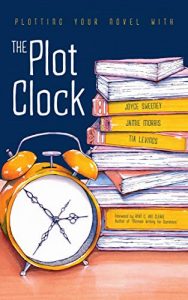
For ten years, I’ve been helping writers extricate themselves from exactly that hairy spot—using a process called the Plot Clock. A virtual AAA road map of a narrative, the Plot Clock shows writers how to organize story events to get their characters to make the changes needed to fulfill their story’s purpose.

As Gail Shepherd, author of THE TRUE HISTORY OF LYNDIE B. HAWKINS (Penguin), says, If you want to nail story structure, there’s no better method than the Plot Clock—it gives you a visual map to represent the arc of your story and keep you on track.

Now, I and my co-authors Joyce Sweeney and Tia Levings have finally written the Plot Clock book. So, if your story is stuck and spinning its wheels, forget AAA. Just call Amazon! Tell ’em to send a literary tow truck—fully loaded with a copy of PLOTTING YOUR NOVEL WITH THE PLOT CLOCK!

Tarot Writing Prompt: If the Moon Were Your Writing Coach

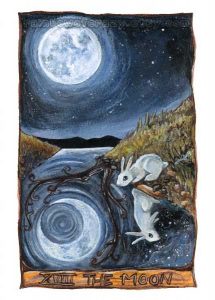
AS WRITERS, WE MAY FIND we want to access our inner depths. Perhaps we need to discover what it is we truly want to say. Or maybe we find our work sounding stale, predictable, even clichéd. At such times, if tarot’s Moon were your writing coach, she’d counsel quiet and self-reflection. She’d suggest you allow your dreams to arise—as she does—in both the sky of your mind and in the quiet pond of your imagination. She’d ask you to contemplate your dreams and your writing by candlelight … or by her own white moth light.

While the Moon knows our inward travels may be fraught with misdirection and mystery, she trusts us to find our way through the dark, face what we discover there, and interpret our nighttime experiences in ways that will illuminate our waking lives and bring deeper wisdom to our creative work. If we explore our depths, rather than fretting about how to monetize our writing dreams too soon, she believes that what we bring forth under her gentle glow will emerge a-shimmer with the magic of our own inner light.

Tarot writing prompts

Taking a page from the Moon’s pillow book, try any of these exercises to dive deep into a character’s dreams … our your own.

1) Keep a dream journal for a month, a “moon.” (Take a look at this PSYCHOLOGY TODAY article for suggestions on how to do so.) At the end of the month, review your journal and see if any silvery, moonlit story ideas emerge.

2) Delve into a character’s psyche by keeping a dream journal for her! Let her reveal her hidden self to you through her dreams.

3) Moon-mapping: Write about an incident, fictional or otherwise, according to the phases of the moon.

  • New moon: the incident’s inception, its seed, how it starts
  • First quarter: how the incident gains traction, its early developments
  • Full moon: how the incident fulfills its initial promise (or threat)
  • Last quarter: how the incident and its effects wane
  • Dark of the moon: like the tide pulling back the ocean to reveal an altered shore, write about what’s left after it’s all over.

4) Write a scene that takes place in broad daylight. Rewrite the scene so it takes place by the barest gleam of the new crescent moon. What’s different?

5) Write a scene in which your character dreams about a situation from her waking life. Of course, dream-fashion, her sleeping self distorts the situation—but in a way that reveals a truth she hasn’t permitted herself to see till now. She wakes, journals about her dream—or tells it to someone—and then acts on the realization her dream has delivered to her. You, writer, take it from there.

Novel-writing inspiration

MARIANNE DREAMS, by Catherine Storr

THE PILLOW BOOK, by Sei Shonagon

THE ART OF DREAMING, by Carlos Castaneda

Thanks to Joanna Cheung for kind permission to use the image of The Moon from THE ANIMISM TAROT.

Posted in News, Notes & Quotes | Comments Off on Tarot Writing Prompt: If the Moon Were Your Writing Coach

Tarot Writing Prompt: A “Hero” and a “Villain” Walk into a Novel

LIKE THE SET-UP FOR A BARROOM JOKE, we begin our novels by collecting players: the hero, a good guy, aka protagonist; and the villain, a bad guy, aka antagonist, the one whose job it is to make things tough for our hero … just so she can outwit him and end up, well, a hero, at the end of the day. At least that’s how she sees it. But I’d bet good money our villain sees things quite differently!

“History,” they say, “is written by the victors.” Likewise, most novels are written if not by heroes, at least in sympathy with them. But what about the bad guy? Because, turn a story inside out, and we can see that the hero thwarts the villain’s aims just as surely as the villain thwarts the hero’s. Yet, where’s the sympathy for that?

For example, in this illustration, it’s clear the retreating figure in the red cape has done the good-looking guy in the blue cape wrong—ten-swords-in-the-back’s-worth of wrong! But what if there’s more to the story? What if, in his eagerness to forward his own goals, young Mr. Blue Cloak neglected to take Red Cloak’s rights into account?

What if, before things came to this terrible pass, Red Cloak had tried to assert her claims, but that darned Blue Cloak guy just ignored her and kept tromping towards his own goal, with no thought for how it was undermining hers? Sure, it’s a shame she had to stab handsome Mr. Blue Cloak in the back ten times. But from Red Cloak’s perspective, it may be she just did what she needed to do to protect her interests.

So, why, she wonders, won’t anyone else see it from her point of view?

Well, what if we did? What if we agreed there are two sides to every story: the hero’s and the villain’s? And which is which depends entirely on our point of view?

Tarot writing prompt

Scene 1: Give a character a goal. That’s your protagonist, your hero. Give a second character a goal diametrically opposed to that of the first character. That’s your antagonist, your villain. Her job is to actively counter your protagonist’s efforts. Write a scene in which their competing goals force them head to head. This time, do so from your protagonist’s point of view, creating as much sympathy as possible for her.

Scene 2: Now, reverse their roles, writing about the same situation from the antagonist’s point of view. Show exactly how the former hero’s actions towards her goal undermine the former antagonist’s progress towards her goal. Make us sympathize with the former villain as much as we did with the hero when we were reading the previous scene.

This exercise could be good practice for writing, say, a psychological thriller, perhaps a story in which you want to keep your characters’ respective good-guy/bad-guy roles a mystery at first. In that case, you might want your reader to start by sympathizing with one character, only to realize that she is actually a freakin’ psychopath, who has been playing not only the other characters in the story, but your reader, as well. Then, maybe, the character who was wrongly perceived steps forward into protagonist-hood and heroically saves her own bacon!

Or vice-versa. Because, as I might have mentioned, “History is written by the victors.”

Novel-writing inspiration

Want to check out a couple of novels that turn the antagonist/protagonist dynamic on its conventional head? Try Gregory Maguire’s WICKED and his CONFESSIONS OF AN UGLY STEPSISTER.

You might also find this Wikipedia article about The Rolling Stones song “Sympathy with the Devil” interesting. Dark and challenging, perhaps, but interesting.

The image of the Ten of Swords, above, is from the EVERYDAY WITCH TAROT deck, written by Deborah Blake and published by Llewellyn Worldwide, and is used here with kind permission by EWT deck artist, Elisabeth Alba.

Posted in News, Notes & Quotes | Comments Off on Tarot Writing Prompt: A “Hero” and a “Villain” Walk into a Novel

Writing a Novel? Tarot’s Two Cents

BE IN NO RUSH TO REVEAL ALL AT ONCE! Be free and let life find its own pace. I am patience, and I am fruition’s reward. In me you will find the fertile ground in which to plant your seed and the patience to watch it grow to abundance. 

So says The Empress, in Emily Carding’s TAROT OF THE SIDHE—expressing sentiments with which no first-time novelist has ever agreed. Not once.

I sympathize. The fact that things take time can be infuriating. But, as the King of Prussia says (over and over) in AMADEUS, “There it is.”

This makes me think of my friend Mel, who is healing from hip surgery. She’s young, so she’s healing relatively quickly. But evidently not quickly enough. “I didn’t know it was going to take so much time,” she cried plaintively last week, after the drugs—and the novelty—wore off.

Like Mel to her repaired hip, new writers often come to a novel-writing coach astride a straight-ahead steamroller called Let’s get ‘er done. But (like Mel!) when they begin to understand that, as with most big endeavors, chances are good it won’t be quick—that they won’t be writing their book just once, from beginning to end—they ask, understandably, “Well, how long? Like, a few months? Six months? A year?!?”

And that’s when I have to share the awful truth, the thing none of us—not me, not Mel, not a new novelist—wants to hear: Things take the time they take.

We can stamp our feet (not you, Mel) and declare whatever ultimatum we want to our creative (or healing) process: “Well, I’m going to have it done by June.” Or Christmas. Or the family reunion (so I have something to show after all these years!). And if it’s not finished by then? “I’m going to _________.” (Fill in the blank: “Quit?” “Throw the laptop out the window?” “Get a job at Walmart?”)

But none of that sways the process. It will take the time it takes.

What does help, as I’ve learned by painful trial and error, is staying the course. Riding that darned steamroller to the end of the tarmac—no matter how seemingly endless the runway. Because, while art (or healing) may require more patience from us than we feel we can muster, the rewards of both are great.

And if that is not consolation enough, maybe this is: Our above-quoted Empress also says, You are safe in my hands as you grow and journey towards completeness. I will support you and bring you all sustenance, that you may bring the same to others.

Thanks to Emily Carding for her permission to share The Empress from her TAROT OF THE SIDHE (Schiffer Publishing) and to quote from the text. 

Writing Short

I’M A SHORT-FORM WRITER, MYSELF: blog posts, personal essays, flash fiction … and, for publication, writing about tarot. Even when I’m embarked on a book-length project, I tend to think about it as being composed of a series of short pieces. It keeps me from being overwhelmed. You know: forest, trees. Or, as Anne Lamott puts it in her book of the same name, “bird by bird.”

This approach can work for folks who are writing novels or memoirs, too. In that case, creating a list of scenes—short forms in themselves—based on a well-considered outline can break down a book-length narrative into bite-sized pieces.

And then there are the super-short forms of fiction, from flash fiction (typically under 1000 words) to those variously named forms (well-described in an article in The Writer Mag: Expert Tips for Writing the Best Flash Fiction) that require a writer to get their story-telling job done within 100 or even 25 words!

While writing shorter forms is less daunting than, say, embarking on a 100,000-word novel, to do so successfully, it helps to know rules that make these forms work.

I found Susan Doran’s discussion of flash fiction and other micro fiction in her article “Lean Mean Writing Machine: Flash Fiction and Other Short Fiction Formshelpful. But, as I reviewed her tips, and those on Creative Writing Now’s short-short stories page, I was struck by how applicable the guidelines for writing short-shorts are to longer forms of narrative writing.

Which sort of brings me full circle. Even for longer projects, breaking things down into micro units can make what seems an elephantine task digestible. And if you have some rules for those micro units? All the better to eat you with, my dear!

A Book Can Be Your Writing Coach!

ARGH! THE DAYS OF A STUCK WRITER CAN BE FILLED WITH DRAMA. Unfortunately, that drama is generally not the kind that reads well on the page. Nope. All too often, when we’re stuck, our days (and heads) are filled with the kind of internal drama that keeps us from even getting to the page. Or is that just me?

If not, if that might, sometimes, be you, too, I have a shortlist of get-the-drama-out-of-my-head-and-onto-the-page books to share. Time and again, whether I’m making things overly complicated or doubting the direction of my work-in-progress, I reach for one of these five books to unstick me. I hope they serve you as well as they’ve served me!

My “let’s get back to writing” coach

I turn to JULIA CAMERON’S THE ARTIST’S WAY when I’ve been creatively sidelined for too long, Like nothing else, the basic tools of the Artist’s Way—morning pages and artist dates—bring my imagination back to life! After just a few days with Julia, I reliably find myself writing (and cooking and art-making) again.

My “find my writing voice” coach

NATALIE GOLDBERG’S authentic voice sings out from the essays that comprise WRITING DOWN THE BONESHer exercises and advice remind me it’s my authentic voice that makes my own writing sing.

My memoir-writing coach

Although I think PAT SCHNEIDER would characterize herself as a poet, I always seem to write memoir in response to the writing prompts in her WRITING ALONE AND WITH OTHERS. They take me back and elicit sweet, deep writing about my past.

My novel-writing coach

In YOU’VE GOT A BOOK IN YOUELIZABETH SIMS’S friendly, no-nonsense approach helps when I need to make a freakin’ plan for a longer writing project. I’m not writing a novel at the moment. But, boy, when I am, I’ll be turning to page 1 of Ez’s book, pronto!

My writing business coach

When I just need to laugh, just need to remember that most writers are crazy—not just me—yet they still get published, still deal with the demanding world of the writing business as well as their sometimes-treacherous inner worlds, I pick up ANNE LAMOTT’S BIRD BY BIRD. Invariably, it restores both my sense of humor and of proportion.

As JUDITH GUEST says in her foreword to WRITING DOWN THE BONES: It would be wonderfully efficient and clever for us writers to have learned our lessons only once; failing that, a copy of Writing Down the Bones on a table nearby could save a lot of grief.

I agree, Judith. And I’m piling all these other books right on top of Bones.


1 3 4 5 6

Copyright ©2026 Jamie Morris LLC| Contact | Privacy Policies | Terms & Conditions