I’M A SHORT-FORM WRITER, MYSELF: blog posts, personal essays, flash fiction … and, for publication, writing about tarot. Even when I’m embarked on a book-length project, I tend to think about it as being composed of a series of short pieces. It keeps me from being overwhelmed. You know: forest, trees. Or, as Anne Lamott puts it in her book of the same name, “bird by bird.”
This approach can work for folks who are writing novels or memoirs, too. In that case, creating a list of scenes—short forms in themselves—based on a well-considered outline can break down a book-length narrative into bite-sized pieces.
And then there are the super-short forms of fiction, from flash fiction (typically under 1000 words) to those variously named forms (well-described in an article in The Writer Mag: Expert Tips for Writing the Best Flash Fiction) that require a writer to get their story-telling job done within 100 or even 25 words!
While writing shorter forms is less daunting than, say, embarking on a 100,000-word novel, to do so successfully, it helps to know rules that make these forms work.
Which sort of brings me full circle. Even for longer projects, breaking things down into micro units can make what seems an elephantine task digestible. And if you have some rules for those micro units? All the better to eat you with, my dear!
ARGH! THE DAYS OF A STUCK WRITER CAN BE FILLED WITH DRAMA. Unfortunately, that drama is generally not the kind that reads well on the page. Nope. All too often, when we’re stuck, our days (and heads) are filled with the kind of internal drama that keeps us from even getting to the page. Or is that just me?
If not, if that might, sometimes, be you, too, I have a shortlist of get-the-drama-out-of-my-head-and-onto-the-page books to share. Time and again, whether I’m making things overly complicated or doubting the direction of my work-in-progress, I reach for one of these five books to unstick me. I hope they serve you as well as they’ve served me!
My “let’s get back to writing” coach
I turn to JULIA CAMERON’STHE ARTIST’S WAY when I’ve been creatively sidelined for too long, Like nothing else, the basic tools of the Artist’s Way—morning pages and artist dates—bring my imagination back to life! After just a few days with Julia, I reliably find myself writing (and cooking and art-making) again.
My “find my writing voice” coach
NATALIE GOLDBERG’Sauthentic voice sings out from the essays that comprise WRITING DOWN THE BONES. Her exercises and advice remind me it’s my authentic voice that makes my own writing sing.
My memoir-writing coach
Although I think PAT SCHNEIDER would characterize herself as a poet, I always seem to write memoir in response to the writing prompts in her WRITING ALONE AND WITH OTHERS. They take me back and elicit sweet, deep writing about my past.
My novel-writing coach
In YOU’VE GOT A BOOK IN YOU, ELIZABETH SIMS’Sfriendly, no-nonsense approach helps when I need to make a freakin’ plan for a longer writing project. I’m not writing a novel at the moment. But, boy, when I am, I’ll be turning to page 1 of Ez’s book, pronto!
My writing business coach
When I just need to laugh, just need to remember that most writers are crazy—not just me—yet they still get published, still deal with the demanding world of the writing business as well as their sometimes-treacherous inner worlds, I pick up ANNE LAMOTT’S BIRD BY BIRD. Invariably, it restores both my sense of humor and of proportion.
As JUDITH GUEST says in her foreword to WRITING DOWN THE BONES:It would be wonderfully efficient and clever for us writers to have learned our lessons only once; failing that, a copy of Writing Down the Bones on a table nearby could save a lot of grief.
I agree, Judith. And I’m piling all these other books right on top of Bones.
TEN DAYS AGO, MY BRAIN FELT LIKE TWO STONES RUBBING TOGETHER. That is to say, after meeting several breathtakingly rushed editing deadlines, I was exhausted. Or, the part of my brain that generally delights in pulling creative writing solutions out of my head like an entire warren of rabbits from an extra-tall magician’s hat? That part was exhausted. So, I was not surprised that the Four of Swords appeared during my daily draws that week.
Tarot speaks
As you can see, the Four of Swords suggests a time out, a long winter’s nap, a little chill-time—in a medieval crypt, if you can’t find any other quiet place to rest your noggin.
And since the tarot Swords suit relates to mental activity, it also suggests we writers may want to take a break from writing, in particular. Which I did. And, as this post attests, ten days later, I’ve hauled my concrete cranium off that sarcophagus, looked around, and discovered my writing mojo waiting for me to grab it—like the swords hanging over our maybe-dead guy’s (very pretty) head.
So, yeah, sometimes, if you’re exhausted and your pretty head needs a break, maybe don’t write. Maybe read, instead. Or watch a movie. Or go to an art museum and poke around. Whatever will refresh those gray cells of yours so they can happily get back to work on your novel … or memoir … or doctoral dissertation.
On the other hand, sometimes we need more than a vacation from our work-in-progress. Sometimes we need something along the lines of an epiphany—if not an entire paradigm shift. It may be that our story has stalled, not because we’re out of gas, but because we’ve lost hold of the invisible silken thread that’s been guiding us through the forest of our writerly unconscious. Or because we’ve suddenly recalled something we suspect will seriously upset one or more people who might read the memoir we’re drafting. Or because we’ve discovered something in the course of our research that completely upends the foundation of our thesis.
In all of those cases: uh-oh!
Then, rather than taking our cue from sleepy-headed Mr. Four of Swords, we might look to The Hanged Man for guidance. The Hanged Man’s reversed position allows him to see things differently. And the fact that he’s tied to that tree ensures he’ll be hanging out there until the needed insight dawns.
So. While no one here’s suggesting you strap yourself to a branch and swing upside down, sometimes, when your project’s come to a complete halt, don’t write. Instead, daydream, or talk with a counselor, or reconsider your understanding of your topic, to name just a few potentially illuminating strategies.
Then, when your own halo of insight lights up, you can haul yourself upright and put your refreshed perspective back to work on the page.
Thanks to U.S. Games Systems for use of images from the Rider-Waite Tarot Deck.
ROXANE GAY IS AN ADVICE COLUMNIST FOR THE NEW YORK TIMES. Recently, she’s received a couple of questions from new/unpublished writers who are growing concerned that middle-ish age (these folks are 47 and 65, respectively) is the wrong time to either start or build a literary career.
In response, Gay says, Throughout my 20s and most of my 30s, I was convinced I was never going to make it as a writer. My writing was constantly rejected, and I took the rejection personally, as one does.
Eventually (obviously!) she met with success—but it wasn’t early success. She says, It is easy to fall prey to the idea that writing success is intrinsically bound to youth. And continues to share her thoughts about the insights that older writers bring to the page—and the world, when given a chance to do so.
There, if you’re a yet-to-publish writer whose 20s, 30s, or 40s are disappearing in the rear-view mirror, you’ll find solid inspiration and encouragement to fuel your literary tank for the next leg of your writer’s journey.
IT’S FRIDAY. THE INFLUX OF WORK HAS ABATED. After hitting send on the last edit in the queue, I pack up three tarot decks, two spiral-bound journals, a small herd of mechanical pencils, a bag of raw pumpkin seeds—and a plan.
The Plan
I’m going to drive the twenty-five miles to Writing Wench’s house out in The Actual Freaking Country, where she lives with her husband and fifteen cats (give or take; she doesn’t count them, she says, because she really doesn’t want to know how many she has).
Once there, I will hunker across the yellow Formica table from WW, and we will write, she, revising a chapter in her novel-in-progress; me, drafting a blog post for September—about tarot’s Hermit card. I hope.
The Journey
I continue to underestimate the plague that is Central Florida traffic, so I get stuck on Red Bug Lake Road near Tuskawilla Road, albeit in a drizzly rain that drops the temperature from a brutal 93 degrees Fahrenheit (do I need to qualify that as “brutal”?) to a semi-bearable 87 degrees. At the side of the road, where traffic has entirely halted my progress at the entrance to Willa Springs Village shopping plaza, a young man holds up a neatly Sharpie-markered cardboard sign: Homeless. Food. Clothes. Anything. Please help.
His not-quite-shoulder-length blond hair looks clean (not that it needs to; just a point of fact), as do his face and his long-sleeved chambray shirt. Drastically bowlegged, he pitches side to side as he walks along the berm, as if his pelvis has been broken at some point.
I roll down my passenger side window. “Can I get you something to eat from Publix?” I call. He lurches over. His face, I see now, is softly freckled, his eyes, pale blue. He looks young. Misplaced.
He’s not hungry, thank you, he tells me, but would really enjoy a bottle of whole milk.
(Whole milk? How wrong is it that I wonder for a moment if whole milk is somehow used to cook or otherwise prepare a drug I’ve never heard of? Probably pretty wrong. On the other hand, what do I care—even if it is?)
I pull out of the snarl of traffic and into the relative calm of the Publix parking lot, heart lifted because I have a mission. Inside the supermarket, I dismiss the idea of getting the young man organic grassmilk—milk produced by grass-fed cows—as it might taste too “green” to him, a bit sour. Instead, I settle on a quart of whole, homogenized T.G. Lee Dairy milk: Our Farmers Pledge NO Artificial Growth Hormones. I also get five dollars in cash at check out.
In the fifteen or so minutes it’s taken me to get back to the young man at the side of the road, the drizzle has stopped and the heat returned, so that, when he thanks me for the quart of milk and the five dollars, sweat is beading on his forehead and a rivulet trickles down his nose. After a moment, in which I realize there is probably nothing more I can do to help, I wish him the very best I can wish him and go on my way.
The Destination
At Writing Wench’s table, tea steeping, cats occupying various perches, I take out the Hermit card from each of the three decks I’ve brought and start to consider my blog post. But after a few minutes, it’s clear that all my pen wants to talk about is the young man at Publix. So I let it. Because, while by the bright light of this mid-afternoon sun I can’t see how that story connects to the Hermit, I suspect it does—and that tonight, by the gentle light of the seeker’s moon, I’ll see exactly how.
Tarot writing prompt
1) Plan a (modest) solo journey.
2) Embark. Along the way, allow for interruptions. When one finds you, be curious. Lift the lantern of your heart to see what there is to see. And if you happen to meet the Buddha on the road, in whatever disguise, don’t kill him. Instead, ask how you can be of service. Then, having done what you can do, continue on your journey.
3) Once you reach your destination, pour a cup of tea and write about where you’ve been.
This post was inspired by the Hermit of the tarot deck. The Hermit, a loner, is often shown cloaked, in the moonlight, holding up a lantern to indicate a search for spiritual understanding. The Hermit’s quest, of course, can take him inward, as well as on the road. Ours, too. Because all of life is a quest and we, perhaps, all Hermits, seeking our truth.
IT WAS THE DAY BEFORE my father’s last Father’s Day. As was our custom, we were hanging out at Barnes and Noble, and my father told me to go pick out a book. Which I did. Then he inscribed it:
If tomorrow were Pal’s Day, instead of another tired Father’s Day, you’d get the flower for being the BEST PAL of ALL, signed, Daddy.
This sentiment may or may not have been accurate. But, at any rate, it was certainly only part of the story.
Another part of the story is this: My relationship with my father was like dancing with a lion in a cage. In this dance, a father-daughter two-step, I struggled to assert my own strength, while he unfailingly maintained the whip hand. Not, by the way, that this seemed much different to me than his other relationships—with his wives (all four of them), his other kids, his stepkids, his siblings, his colleagues.
A professor of philosophy, my father had little of the equilibrium, the perspective, the tolerance of his fellow human being you might expect of a person who has spent a lifetime studying higher thought.
Instead, he was often slashingly critical. Even vicious. Sometimes, even violent. And he was not to be questioned. For instance, once, when I asked if he had ever hit my then-adolescent stepbrother, my father rose up roaring and ordered me out of his house.
And he never really mellowed.
For my part, over the years, I alternately challenged my father and tried to appease the beast that lived inside him. For his part, he backed, against all comers, that beast—a beast that, to the end, was never done roaring.
Of course, this, too, is only part of the story.
Tarot writing prompt
Set aside thirty minutes of journaling time. Allow your writing to reflect on a less-than-perfect relationship—perhaps with your own father or a father figure. What power struggles occur within the relationship? What role do you play in that dynamic? Can you give concrete examples to illustrate the struggle?
Next, consider what might happen if you were to challenge the power dynamic, even gently—by asking a question, for instance, or changing your own behavior in some small way. Play out that potential shift by writing a scene about it.
If this personal approach cuts too close to the bone, write about a fictional character, instead, and spend some pages examining their relationship with their father.
This post was inspired by the Strength card of the tarot deck, which can refer both to our use of our personal power and to the taming of various instinctual aspects of our personality. Strength is a neutral attribute: Awareness, intention, and mastery of self all help us to use our strength wisely.
In this version of Strength, from LEGRANDE CIRCUS & SIDESHOW TAROT, the lion tamer seems to have met her match. It’s up to the viewer to imagine how this dance will end. (Image used by kind permission of U.S. Games Systems.)
BETTER THAN A THOUSAND DAYS OF DILIGENT STUDY is one day with a great teacher. So says an old Japanese proverb. But you won’t even need a whole day for this exercise! You might, however, want to set aside an hour or two … perhaps with a cup of tea at your side. You’ll also want to gather some supplies: paper, a pen, and something to bookmark passages—highlighter? sticky notes? We’re going old-school, here!
Tarot writing prompt
First, choose your “teacher.” This would be a writer whose style you really admire. Grab several examples of her work—articles, books, essays, stories, poems, depending on her genre—to have at hand. Next, take your time browsing through the pieces you’ve chosen. Be on the lookout for passages (lines? paragraphs? scenes?) that are particularly pleasing to you, and bookmark them in some way.
After you’ve made it through your stack, revisit the passages you’ve marked. Now, grab that pen and a piece of paper and, simply, but with Zen-like attention, copy one (or more) of the passages exactly. This will give you almost a literal feel for the way the author puts together a paragraph (or composes a stanza or delivers a punchline). As you write, notice which parts of the passage give you particular pleasure to copy.
Once you’ve completed your copy-catting, take a few moments to name (in writing—bullet list, anybody?) what you think the writer is doing particularly well in that passage. Then, imagine how you might benefit from (further) developing the skill(s) the author demonstrates there.
FOR EXAMPLE
I picked a passage from the first chapter of Julie Compton’sRescuing Olivia(used with permission) which I particularly admire.
“Mr. Mayfield?”
[Olivia’s] father looked up over the top of the reading glasses as if he was surprised to see Anders still in the room.
“Did I do something to offend you, sir? Is there a reason you don’t want me to see her?”
The man leaned back into his chair and sighed. “Olivia’s mother and I think that you have done quite enough for her, Andy. I’m sure the two of you have had a hell of a time together—God knows I cringe to think of the details—but it’s time for her to come home and be with family. If she’s lucky, that is.”
For a moment, Anders stood speechless, staring at him and trying to process the meaning of what he’d just said. What he’d just accused him of. If Anders had been a different sort of man, more like Lenny, he would have considered taking a swing at the guy. But if he’d been more like Lenny, he would never have been standing there discussing Olivia with her father. Olivia would never have been in his life.
“Are you saying you think I caused the accident? That it was my fault?”
Her father had turned his attention back to his damn papers, and he answered this time without even looking up. “You were driving the motorcycle, weren’t you?”
As I was copying out this passage (long hand!), I noticed how much I enjoyed the “For a moment …” paragraph. As internal narration, it both adds depth and meaning to the immediacy of the back-and-forth of the dialogue and balances it well. Also, I love the way it takes me winging out of the present of the scene with Olivia’s father into consideration of Lenny, a character I’ve yet to meet, but now am eager to—implying backstory, as it does so.
Not only does Compton’s use of internal narration and back story not slow the forward motion of the scene, but, somehow, she uses them in a way that creates suspense and builds tension. I’d like learn from this piece how to make internal narration do triple-duty in my own work—and tuck it in as seamlessly as Compton does!
UM … AND THEN?
Once I’ve completed this exercise, I trust my inner writer to take what it likes and leave the rest. At times, I find that I assimilate something of an author’s technique into my own work with little further attention. Evidently, in the words of my pal Kathleen (quoting a Zen master!), “The work will teach you how to do it.”
Here, the Hierophant is represented by Hermione, as “The Scholar,” from nasubionna’s Harry Potter Tarot (used with permission). Hermione is a character who studies conventional ways and wisdom—before putting her own brilliant spin on what she’s learned.
HERE IN THE NORTHERN HEMISPHERE, IT’S FALL, the season of harvest, which rolls steadily into winter, the season of hunkering down, of mending nets, of dreaming in the dark. And what if, under the spell of that winter, in all that dark, during all those long, quiet hours, a dream should catch fire in the belly of the dreamer? Then, like a three- or four-months ripening womb, what was once just a glimmer will start to show in spring, that season of surging rivers, of buds swelling on what were just skeletal branches the day before.
But if that dream happens to be a big writing project? A novel? A memoir? A collection of short stories? Then be prepared: That quickening may take a while. The writing life has its own seasons—among them, a dark incubation, a time when a project may seem to have gone retrograde, to have lost its purchase. That season is the writer’s winter, the quiet dark in which a writing dream twists and threatens to slip between the fingers of our unconscious.
In her essay “Angst and the Second Book,” from her collection THE OPPOSITE OF FATE, Amy Tan writes about the lengthy gestation of her second novel, THE KITCHEN GOD’S WIFE, during just such a writer’s winter.
Each morning . . . I would dutifully sit at my desk, turn on the computer, and stare at the blank screen. . . . I wrote with persistence, telling myself that no matter how bad the story was, I should simply go on like a rat in a maze. . . . And so I started to write . . . about a woman who was cleaning a house. . . . After thirty pages, the house was tidy, and I had found a character I liked. I abandoned all the pages about the tidy house. I kept the character and took her along with me to another house. I wrote and then rewrote, six times, another thirty pages, and found a question in her heart. I abandoned the pages and kept the question. . . . I wrote and rewrote one hundred fifty pages and then found myself at a crisis point. The woman had turned sour on me. . . . I felt like the rat who had taken the wrong turn at the beginning and had scrambled all this way only to reach a dead end.
Tan goes on to talk about many other dead ends she found on her eventual way to THE KITCHEN GOD’S WIFE. She counts seven attempts. Among other morals we could take from the essay is this: A big writing project can take a long time to ripen. During this time, it may look like nothing (or less than nothing!) is happening, but on the inside, things are shifting, developing, taking shape. Given enough time and space, the big writing dream may well grow into something recognizable.
Tarot writing prompt
During these dark months, take time to slip beneath the holiday glitz and glitter and listen to the fluttering hopes of stories that might want to dream themselves awake in spring. Prepare the soil for those that will settle and take root. Listen in the dark for their tiny voices. Jot down what you hear. Keep your notes safe in the quiet of your own heart, until you feel one or more of them stir. Then fertilize, water, and make space for them to grow.
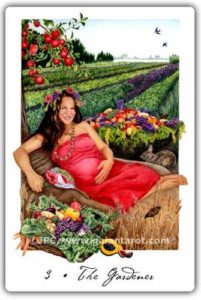
This writing prompt was inspired by The Empress of the tarot deck (shown here as The Gardener, from Joanna Powell Colbert’s Gaian Tarot). Tarot’s Empress is associated with fecundity, fruitfulness, harvest, and pregnancies of every kind—and with the patience and nurturance it takes to bring those pregnancies to term.
IF REVISION*WERE A DOG, it would wear a hat and be foolish in public, because revision would want to get the most DOG out of each moment that it could. If revision were a fish, it would be out of water and dragging its school behind. If revision were an interior decorating scheme, it would cry out for spangle-y pinks and purples—unless it wanted the heat of reds and oranges—unless it wanted the cool underwater of blues and greens.
Sometimes art is the answer—but sometimes it’s revision. Sometimes it’s about seeing your work-in-progress as so many puzzle pieces, which you have to turn and match and try to fit. But sometimes it’s about diving deeper.
Sometimes revision wants to be smacked around, which can be a little scary—unless you have a safe word, and sometimes revision does have a safe word, in which case, it’s okay to play rough, which, sometimes, revision likes.
Revision’s about re-visioning, it’s about looking at what you’ve already done and asking what else you can do. But revision’s not “editing.” If writing were an injury, revision would be surgery, not massage.
Revision is a bit of a shepherd’s crook, tugging you off the stage when you think you’re ready to be out there. Revision knows when you haven’t fully paid your dues. Revision wants you to work harder—it’s stubborn like that. But revision will reward your work with a bag of gold so full you’ll be able to scatter coins far and wide, feeding the entire populace of your life—once you’ve done what revision wants you to do.
* * *
* The art illustrating this post is a before-and-after of a piece I created in one of my art journals. It’s easy, often, to get stalled at an early stage of a piece of art or a piece of writing. Difficult, sometimes, to push through to the next level. Risky, always, to do so.
I’m grateful to Tammy Garcia—creator of Daisy Yellow Art and the extraordinary Daisy Yellow Facebook group—for her continuing inspiration. The lessons I’ve learned from Tammy and crew have helped me be more courageous on the page.
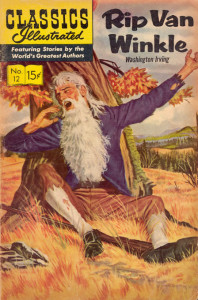
NOVEMBER IS NATIONAL NOVEL WRITING MONTH (or NaNoWriMo, for those of us who like a little shortening with our bread). While NaNo may not be news, it is a great wake-up call for folks whose writing projects made like Rip Van Winkleover the summer. The scoop, according to the official NaNo site, is this: “On November 1, participants begin working towards the goal of writing a 50,000-word novel by 11:59 PM on November 30.” Sign up and receive beaucoup support for this annual challenge.
There’s a NaNoWriMo Young Writers Program, too! The Young Writers Program allows 17-and-under participants to set “reasonable, yet challenging, individual word-count goals.”
We use cookies to understand how you use this site and improve your experience. You can accept or decline — declining may limit some features.
Functional
Always active
The technical storage or access is strictly necessary for the legitimate purpose of enabling the use of a specific service explicitly requested by the subscriber or user, or for the sole purpose of carrying out the transmission of a communication over an electronic communications network.
Preferences
The technical storage or access is necessary for the legitimate purpose of storing preferences that are not requested by the subscriber or user.
Statistics
The technical storage or access that is used exclusively for statistical purposes.The technical storage or access that is used exclusively for anonymous statistical purposes. Without a subpoena, voluntary compliance on the part of your Internet Service Provider, or additional records from a third party, information stored or retrieved for this purpose alone cannot usually be used to identify you.
Marketing
The technical storage or access is required to create user profiles to send advertising, or to track the user on a website or across several websites for similar marketing purposes.