A young adult (YA) fiction writer is seeking other writers for connection and camaraderie.
I want to introduce you to someone! Young adult fiction writer Alina Smith and I have worked together since November of 2017—three awesome years and counting!* In that time, I’ve seen this committed writer dig in and learn how toplot the heck out of a story … then dig even deeper to find truthful motivations for her characters. Those motivations, in turn, lead to powerful arcs that give her stories real guts (and will deliver true satisfaction to her readers!).
I count myself lucky to be on Team Alina and am so happy to pass on her invitation to connect with you. So, without further ado, I give you Ms. Alina Smith!
What’s up guys! I’m Alina. Although I have a pretty sweet day job—I’m a songwriter and producer in a music team LYRE, which has worked with artists and bands across genres, from Fall Out Boy to K-pop girl group Red Velvet-–over the past few years, I’ve gotten excited about writing stories. Particularly futuristic YA stories with chilling twists on current technology: think BLACK MIRRORpopulated by hormonal teenagers.
I started writing my first Young Adult Fiction novel three years ago and got about two-thirds of the way in before being pulled into a new direction, one which merges my music career and my literary passion. You see, in the last few years, LYRE has become known for working with digital creators: influencers with millions of followers across all social media platforms. As my music partner, Elli, and I wrote songs with these YouTube and Instagram stars, I felt myself getting immersed in their world: a world where your worth depends solely on the numbers of likes and followers on your socials. It got me thinking: What if this world was exacerbated further? What if the numbers on your socials meant life or death? That’s how the idea for my latest book was born. It’s called “Influencer.”
As I’ve been writing “Influencer” (one-and-a-half years and counting!), I’ve done plenty of Google searches. I’ve checked out writers’ blogs, advice columns, and YouTube channels. It’s been fun watching published authors share bits and pieces of their journeys. But it got me wondering: Are there any not-yet-published writers sharing their process with the world? Their aha! moments and their blocks, their triumphs and fails, their I-just-finished-this-act underwear dances, and the moments when they just wanna throw their laptop through the wall? I poked around, but there didn’t seem to be much: no hungry new writers diving into their process and allowing others to snorkel beside them.
That’s when it hit me: I should share my own writing process! My struggles with beat sheets, my ever-evolving characters, what it’s like to find time for writing alongside another creative career—and all the other myriad aspects of the novel-writing process that I find fascinating. Whether I become a hit author or end up throwing my story in the trash and setting it on fire, I want to highlight what it’s like to be a first-time novelist. And I hope to connect with anyone else who’s going through the same thing.
So, please join me on this fun (and slightly terrifying journey) on my YouTube channel: Alina Writes a Book.And if you’re writing YA fiction, too? Please, drop me a line on Instagram or Twitter. I’d love to hear about your story and your journey creating it!
Writing coach
* Alina’s loving our collaboration, too! She recently wrote, Jamie is such a fantastic coach! Her approach is very intuitive. No matter what I’m working on, from plotting to character development, she always has an intelligent, unique perspective. If you’d like to take your writing to another level, I strongly recommend Jamie!
TERI ANPOWI SAVELIFF AND I WERE TAROT FRIENDS before we were writer friends. Many’s the evening we’ve spent on the phone throwing cards for one another or sharing images from our newest decks. Then I read her charming NaNoWriMo-inspired novel, SIGNATURES, and was delighted to learn we had a whole other dimension of commonality to explore—including plotting a novel!
In this post, Teri draws from our shared worlds, offering three ways to use tarot—a system of evocative visual images—to develop your novel. Here are her tips for plotting a novel.
* * *
Before I published my first novel, SIGNATURES, the main characters and the bookshop where they worked had been inhabiting my head for decades. But characters, and even settings, have lives of their own, and they may insist on telling their story in ways you might not anticipate. As an avid student of tarot, I knew the cards would play a role in my novel. And I was right. Once tough-talking, tattooed Paloma—complete with her tarot deck—strolled into the bookshop and insisted on joining my cast of characters, she and her cards played a very large part in my novel, indeed.
In the past, I’ve often used the images, symbolism, and divinatory meanings of tarot cards to illustrate a point or move a plot along. In SIGNATURES, however, I didn’t merely toss the appropriate card into the story at the right time—I conducted actual readings for my characters. If you have some experience with tarot, I highly recommend this strategy when you need additional backstory for a character, want to test a character’s mettle, or want to explore secondary themes in your novel.
You don’t need to be a tarot expert to find the cards useful, however! Here are three different ways you can use a deck of tarot cards to explore your novel.
Tip #1 for Plotting a Novel
Know a smidge about tarot? Conduct a tarot reading as part of a scene.
One late addition to my cast of characters was Hanz Lippman, an author clinging to past achievements. He enjoyed holding court in the bookshop and flirting with coeds studying his book in their literature classes. I didn’t anticipate developing his character, further, though, until Paloma conducted a reading for him:
“Don’t draw more than one card,” commanded Hanz. “I don’t think I could stand any more than that.”
Paloma made a face and drew a solitary card. It depicted a young man, a small dog nipping at his heels. The man was perilously close to the edge of a cliff, but seemed unconcerned.
“The Fool,” said Paloma. “You seem to be at the beginning of a journey or undertaking.”
“Ha!” crowed Hanz. “I knew these cards were nonsensical bullshit. Tell me, dear, what sort of journey am I beginning? What project am I undertaking?”
“Well, this is usually why my client and I work together,” Paloma answered irritably. “I’ve told you, I’m not a fortuneteller. I would also draw a few more cards to answer the question. One card doesn’t always say enough.”
“My sweet little dove,” Hanz said with a smile, “I am far too old to be a fool, at the beginning of a journey or otherwise. You should have drawn an old man … a man without even a dog to accompany him on his travels.”
“The Fool can also represent someone at the beginning of a spiritual journey … or an emotional journey,” Paloma added.
“None of this resonates at all,” Hanz insisted stubbornly. He turned the card face down and slid it back toward Paloma.
“Of course, you could also be getting ready to walk right off the cliff,” Paloma retorted. “Not looking where you’re going, too confident in yourself. The good news is, the fall won’t be fatal.”
“Good news for whom?” teased Hanz. “I have a feeling you wouldn’t mind if I broke a bone or two.”
Paloma smiled noncommittally and gathered the cards into a single stack.
This reading added some depth to Hanz’s character and inspired me to create for him a much bigger role in my novel.
Tip #2 for Plotting a Novel
Not a tarot reader? Just one image can add intrigue or foreshadowing
Even a single card can add dimension or reinforce a theme in your story. The card may appear very straightforward, such as the card of Justice, usually depicting a blindfolded woman with a sword in one hand and a set of scales in the other, or The Tower, often shown with lightning striking its peak and people falling from its windows.
In the case of this little scene, Maggie, the main character in SIGNATURES, draws her own card out of curiosity, and that card adds a bit of foreshadowing.
[Maggie] spied Paloma’s tarot deck sitting on the low round table not far from the window. On an impulse, she shuffled the cards and then drew one from the deck. She had to laugh. “The Lovers,” she smirked.
It so happens that Maggie pulled this card just before she goes on a date!
Tip #3 for Plotting a Novel
Don’t know the first thing about tarot cards? Tarot is character-centric! Let the figure on a card suggest an attitude or trait for one of your less-developed characters. (P.S. The internet abounds with pictures of tarot archetypes. Just Google “tarot cards” for a free treasure trove of inspiring images!)
You don’t need any experience with the cards to put them to work as a literary aid! Since tarot’s visual language can be said to be universal, even the most random tarot draw can spark fresh ideas. For instance, If you are looking to add a character to your story, or describe a character you haven’t fleshed out, you could draw a card to give your character a face.
One of my favorite decks, the GAIAN TAROT, depicts people from numerous ethnic backgrounds and cultures. When I was looking for a bit more information about the character of Paloma after she barged unexpectedly into my book, the GAIAN Seven of Fire suggested her multiple tattoos and air of independence.
Whether you utilize a few captivating illustrations on the internet, purchase an intriguing deck of your own, or become a full-blown tarot enthusiast like me, tarot can enrich and add dimension to your writing endeavors. Above all, have fun exploring a new tool!
* * *
WRITING (AND TAROT) INSPIRATION
If you want to try this tip for plotting a novel there are literally thousands of tarot decks to choose from. You might visit Amazon and search “tarot decks,” to get you started. However, the AECLECTIC TAROT site might be a better place to start. AECLECTIC offers decks categorized by art style, as well as sample images of all decks and even reviews of many decks.
Corinne Kenner’s TAROT FOR WRITERS offers many approaches to applying tarot imagery and meaning to enhance your creative writing project.
You’ll also find dozens of tarot-based writing prompts on this website. Just search “tarot,” using the magnifying-glass icon you’ll find in the top right hand corner of every page.
IF TAROT’S QUEEN OF WANDS WERE YOUR WRITING COACH, she would be your enthusiastic champion, your star-spangled cheerleader! She’d laud your literary talent and encourage you to hold to your creative vision, even when others question it. You see, she believes your pen is your magic wand—that it brings to life the imaginative worlds that live inside you.
An independent sort herself, the Queen of Wands would advocate for your independence. She’s not a joiner, so she wouldn’t necessarily suggest you find yourself a critique group. But she’s a hard worker and would expect you to be one, too. In her no-nonsense style, she’d tell you dig in—and maybe hand you a bullet-point list like this one to show you exactly what she means:
Read widely in your genre—especially books that have been published in the last three years.
Subscribe to writing magazines like THE WRITER and WRITER’S DIGEST that have their finger on the pulse of publishing.
Check out blogs and YouTube videos that feature literary agents weighing in on what makes a book attractive to them and what doesn’t.
Take classes—online (Gotham Writers has a good reputation) or at your local community college, no matter. Just open your heart to how others approach the craft. Then, take what you like and leave the rest.
Create a writing schedule—and stick to it.
Finish a draft, then get a good reader to review it (you might hire a pro, ask the smartiest smarty pants in your book group to take a look, or trade for pet-sitting with a neighbor who talks regularly and intelligently about the books she reads).
And after you’ve done all that, the Queen would give you a high five, pat you on the back, and tell you, in her heartiest voice, to go back now and revise, revise, revise.
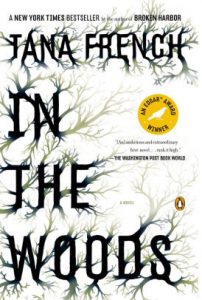
JILL AND I MEET EVERY SUNDAY TO WALK, talk books and life, and watch something on TV. Lately, our book chat and viewing choice have coincided as we’ve watched—and discussed—DUBLIN MURDERS. This eight-episode series is based on two Tana French mysteries: IN THE WOODS and THE LIKENESS.
Both books have powerful, intricate plots. So we were interested to see that screenwriter Sarah Phelps’s television adaptation has dovetailed their plot lines—creating a single interwoven narrative of the two stand-alone mysteries.
The novels (spoiler alert!)
IN THE WOODS: When Detective Rob Ryan was a kid, he and two of his friends went into the woods near their home in Knocknaree, Ireland, to play—but only Rob came out, and he remembers nothing of what happened that day. Author French flings wide a door on the possibility that the mysterious disappearance of the two other children had a supernatural cause. Certainly, the incident continues to haunt Rob twenty years later, its long shadow creating an enticingly spooky atmosphere for the present investigation, the murder of young Katy Devlin, whose body was found in those same woods.
Rob and his partner, Detective Cassie Maddox, are assigned the case, giving Rob the opportunity to reopen inquiries into the still-unsolved disappearance of his childhood friends. But what only Cassie knows is that Rob—who was once called Adam Ryan—is the same kid who emerged, alone, physically unharmed but profoundly disturbed, from the Knocknaree woods in 1984.
Having hidden his identity for twenty years, Rob is confident no one will associate him with young Adam. This identity sleight of hand is important because, if anyone besides Cassie knew who he was, Rob would be thrown off the case—and now that he’s back in the woods, Rob is not going to rest until he finds out what happened to his friends, and to Katy Devlin, and whether the tragedies are connected.
THE LIKENESS: French’s second novel, THE LIKENESS, picks up some months after IN THE WOODS ends. Although Rob is mentioned here, he is no longer a relevant character; it’s Cassie’s story entirely. While an unlikely coincidence pulls the trigger on this story, there is no hint of the uncanny in the book—only a healthy dose of psychological drama. Hoping to tease out her doppelgänger’s killer, it is Cassie, now undercover for “Operation Mirror,” who is playing cat and mouse with her identity.
The screenplay (spoiler alert!)
DUBLIN MURDERS: As I mentioned, for the TV production, the plots from these two novels have been twisted together to make a single story. This has been accomplished in several ways. Among them is the anticipated construction of a roadway, which originally threatened just the titular forest of IN THE WOODS, but now also touches the manor house at the center of the action in THE LIKENESS.
Also, in the DUBLIN MURDERS script, the plot from THE LIKENESS has been twisted to create a follow-up to a tragic childhood accident for Cassie—one that’s scarred her psyche every bit as much as Rob’s mysterious experience in the woods has scarred his. But while in the original telling of IN THE WOODS Rob’s backstory is as deeply entwined with the current-day tale as the vines winding among the trees of the Knocknaree woods, neither IN THE WOODS nor THE LIKENESS includes much of Cassie’s backstory at all. From them, we discover little about her that predates her time as an undercover officer, just prior to her partnership with Rob on the Dublin Murder Squad.
But, like author French does with the disappearance of Rob’s young friends, screenwriter Phelps imbues the tragedy in Cassie’s childhood with more than a hint of the supernatural—developing both a parallel to Rob’s mysterious backstory and giving the heretofore no-nonsense Cassie as tangled a personality as Rob’s by doing so.
With this addition, Phelps inflates an issue of identity confusion that’s at the foundation of THE LIKENESS’S murder investigation. In the TV version, when Rob’s and Cassie’s stories diverge, and Cassie leaves Rob alone with the investigation of the Knocknaree murder to go undercover on Operation Mirror, that now-sensationalized thread colors Cassie’s experiences, quite lividly.
Sensational? Or sensationalized?
Jill and I agree that DUBLIN MURDERS is a dynamic, suspenseful—often pulse-raising—adaptation. It was exciting to find ourselves in the midst of unfamiliar narrative territory, rather than just watching a stylish retelling of books we know so well. But for me, this retelling feels over-hyped, relying as it does on Cassie’s manufactured—gratuitous—response to an early tragedy. (In this opinion, Jill and I are not in absolute agreement.)
As much as the series titillated me as a viewer, as a reader, I leave it feeling overstimulated, as if I’ve eaten an entire fluffy cone of hot-pink cotton candy and now there’s too much sugar racing through my brain. (I’m planning an early 2020 re-read of THE LIKENESS to settle myself back down!)
Books vs. movie adaptations
When I discussed my concerns about DUBLIN MURDERS with ghostwriter/freelance editor pal Tom Wallace, he said, Reading a book is more active, and watching a movie or TV show is more passive. Books demand you be engaged. You’re doing some work, making more of a contribution to the story. When you read fiction, you have to use your imagination, bring something to the characters, the setting. This develops more intellectual muscle [than watching films], the ability and inclination to invest real thought and imagination.
Tom also mentioned the compression of story common in movie adaptations, citing Michael Chabon’s novel WONDER BOYS for example, saying, Reading the book is a much richer experience. If you read the book first, when you’re watching the film, you get to spots where you think, “It’s thin right there,” because the screenwriter [Steve Kloves] has had to connect two important plot issues with a very thin line. They’re under a time constraint. Everything has to fit into 120 minutes. Because the screenwriter doesn’t have time to fully develop the threads between plot points, those spots can feel thin. But when you read Chabon, nothing feels thin; he doesn’t write anything he’s not going to write in a rich way.
(Interestingly, where Tom finds Chabon “rich,” Jill finds him dense and says she connected more to Kloves’s WONDER BOYS adaptation than to the novel.)
Episodic
I’m glad to say DUBLIN MURDERS doesn’t suffer from this sort of compression. Too often, though, while film adaptations may be true to the events of the book, they end up feeling episodic—quick-juxtaposing one important scene after the next. Although they may hit every plot point, as Tom says, they tend to do so without creating enough space, enough context for those points to unfold organically. Instead, transitions from beat to beat may feel abrupt, making for a fractured, staccato delivery of the story.
(Jill, on the other hand, loves the 2011 version of JANE EYRE and credits screenwriter Moira Buffini with creating both a beautiful translation of the almost 200-year-old book and one that makes the story accessible to a contemporary audience. Also, while Jill did feel rushed by the WOLF HALL miniseries, the authority with which actor Mark Rylance brings to life historical figure Thomas Cromwell made watching WOLF HALL not only a worthwhile experience for her, but, she says, an awesome one!)
Back to Dublin
But let’s return to DUBLIN MURDERS, which, as I said, doesn’t suffer from Oliver Twist syndrome. Still, watching the show as a writer, editor, and lifelong reader, I found myself wondering about this adaptation business. For instance,
What does Tana French think of the screenplay? And other authors whose books have been rewritten for the screen? How do they feel about the adaptations of their work?
Does preparing a book for the screen necessitate significant tightening, tweaking, and manipulation? Is that simply a function of adaptation? Or is such treatment a reflection of our heightened, hyperbolic times?
How often are the often contrived screen versions of novels all that most people remember of the original books? And if they are, is that a loss of some kind? Or does it just preserve the work for our fast-paced world?
And the big question
Is the book always better than the movie?
I think it may be. And so does Tom. At least most of the time. And Rick Riordan, author of PERCY JACKSON AND THE OLYMPIANS, among many other books for younger readers, agrees. In a post on his site titled “Books to Movies,“ Riordan, who is famously unhappy with the adaptations made of two of his novels, writes,
…. very few books … are turned into decent movie versions … [T]he vast majority are dreadful adaptations…. Still, hope springs eternal…. despite the fact that I have never walked out of the cinema and said, “Wow, the movie was so much better than the book!”
Jill, though? She says, “If screenwriters are mining the story in a new way for the their medium, I’m all for that.” And she found a 2013 FLAVORWIREarticle titled “10 Authors Who Loved the Film Adaptations of Their Books” to back up her contention that at least some authors are happy with how the movie version of their work turned out!)
But despite our differences of opinion, Jill and I are proving Riordan right in one thing: Regarding book-to-film adaptation, hope does seem to spring eternal—demonstrated in this case by the Jill’s and my mutual very high hopes for Greta Gerwig’s new version of Louisa May Alcott’sLITTLE WOMEN!
* * *
Thanks to writer friend Teri Anpowi Saveliff for sending me looking to Rick Riordan for his thoughts on film adaptations!
WRITING CAN LIFT US TO FLIGHTS OF FANCY or, like a draft mule, it can pull the plow of practicality from one end of the field to the other. Here, we explore the mule end of the spectrum, with what’s called a “process essay.”
The process essay (which you might remember from your Comp 1 class) offers step-by-step directions to guide a reader through a task. Sure, it’s more about treading the well-tilled field of communication than lifting off into the wild blue of fantasy. But it can be a playful form as well as an informative one—and it’s a good exercise in organizing your thoughts on the page. (Sound too boring to even consider? Look below for some reasons you might want to give it a try!*)
Writing prompt: the process essay (which, with some clever packaging, can double as a holiday gift, if you’re well and truly stuck!*)
Start by identifying a skill at which you excel. It could be something simple, like writing an Amazon review, driving a stick shift, or grooming a standard poodle. On the more complex end of the spectrum, you might know exactly how to prepare for an Ironman Triathalon, paint the exterior of a house on the National Register of Historic Places, or outline a novel!
This is the stuff of YouTube video tutorials … but you’re going to slow it down, writing out each step in a way that a reader can follow. (Think IKEA assembly instructions—only with words … and humanly possible.)
*Why write a process essay?
Since ’tis the season, you might include a process essay as part of gift! For example, you could write out your mulled cider recipe and package it with the ingredients needed to brew up a pot. Or you might wrap up a few dreidels, with instructions about how to play the classic Hanukkah game. Or, if you’re a killer door-wreath creator, along with the wreath you give, share the details of how you fancy up those bauble-laden bad boys!
If you blog or teach or coach, you might want to use this opportunity to create written instructions for something your students or readers would benefit from, then use those instructions in a blog post or lesson. (Handouts, anyone?)
And if you write fiction, writing a process essay can take you deep into your main character’s area of expertise. Our fictional folks have entire lives gliding beneath the surface of the stories we tell about them. Knowing your stuff about what they do and how they do it will add depth and authority to your literary worlds!
Finally, if you really, really, REALLY like doing this exercise, you might have a calling as a technical writer.
Writing inspiration
Want some step-by-step directions to writing your step-by-step process essay? Check out this article on the BEST ESSAY TIPS website.
Travel essays often include aspects of process writing. For instance, the writer might explain how to get to a location, how to stay safe once you’re there, how to find the best bargains, or how to discover the most exotic meals. Check out the 2019 edition of the annual THE BEST AMERICAN TRAVEL WRITING, edited by Jason Wilson and Alexandra Fuller for examples.
YOU KNOW HOW THINGS LOOK DIFFERENT IN THE REAR VIEW MIRROR?A backwards glance can offer us a new perspective on where we’ve been. Like a literary rear view mirror, backstory lets readers know where we—or our characters—have come from. In doing so, backstory can reveal a character’s motivation, which, in turn, may elicit sympathy for that character’s present, less-appealing actions or attitudes.
What is backstory?
A definition
Whether we’re writing memoir, fiction, or a piece of literary journalism, backstory gives context to the story being told. It comprises events—internal (an anxiety attack, for example) or external (loss of a child, for example)—which have occurred before the story starts and are relevant to the story being told.
For example
In a story about a dissolving marriage, the loss of the couple’s child would certainly be relevant. If the child died before we meet the couple, then the death and the characters’ subsequent emotions are backstory—relevant past events.
However
In a story about a woman wanting to break the World Land Speed Record, the loss of the main character’s best friend’s child would likely not be relevant to the unfolding of the main story thread.
How can we use backstory most effectively?
Wait, wait, don’t tell me!
Opinions (of course) vary about how soon is too soon to incorporate backstory. For instance, brilliant film-and-novel-writing guy Robert McKee of STORY fame says to avoid backstory completely for the first three chapters! He believes this gives readers a chance to attach to the forward-moving story, creating a reason for them to care about what’s come before.
Other quite successful writers, however, actually start with backstory. In fact, thriller writer Julie Compton and I created a backstory workshop based on her well-received novel RESCUING OLIVIA, which introduces a fairly lengthy backstory passage quite early in the book. (CLICK HERE to read a post that uses RESCUING OLIVIA’S opening for an example.)
It is typical, though, for writers to hit the ground running. They’ll often start a first chapter in media res (in the middle of the present action), and then, in chapter two, turn back to consider earlier events to give their opening context.
Just say no to the info dump!
An “info dump” is a big chunk of information—especially backstory—“dumped” onto the page all at once. Whether your dump truck delivers your backstory via dialogue, narration, or internal narrative, readers will have trouble processing, and thus, remembering, backstory given in too big a lump.
Breadcrumbs
Instead, think of backstory as breadcrumbs. Scatter small bits along the unfolding story path, informing your reader of what’s happened in the past on a need-to-know basis.
Ways and means committee
Among other techniques, you might deliver backstory via
flashback (a past experience given in scene—including sensory detail and a “real-time” unfolding of events)
dialogue (your characters simply discuss events that happened before the story started)
or as internal narrative (your character remembers events and considers them internally).
Light touch
No matter how you deliver it, though, use as light a hand with backstory as you can. Err on the side of less is more.
Novel-writing resources
Enough about me! What do other folks have to say about backstory?
Finally, if you want to thumb your nose at my light-hand-with-backstory approach, here’s a super-successful memoir that shovels in about one full ton of backstory—in pretty large doses—and does so beautifully: WILD, by Cheryl Strayed.
AS CHESS PLAYERS KNOW, figuring out a strategy takes time. You need to contemplate all your options—and anticipate, as best you can, what will happen as a result of each.
In this way, the Two of Wands is a bit of a chess player. A successful merchant, he is sitting pretty in his villa by the sea, examining the opportunities available to him and evaluating their risks. Since he’s so comfortable, any move he makes must offer enough potential return to make gambling what he’s got worthwhile.
Will he? Make the move? Take the risk?
He doesn’t have to. After examining his alternatives, the Two of Wands could happily turn his back on the possibilities and just retire to his pleasant villa, where, no doubt, a wonderful breakfast has been spread for his enjoyment.
Which is why he’s not actually a chess player. An actual chess player doesn’t have a choice. She has to make her first move, and then another, and another—until checkmate (or stalemate) occurs. In professional chess, there’s even a timer to push the players along. But there’s no timer for the Two of Wands. No real urgency to make a move. Because of this, he’s only banked embers, only stored potential—unless he acts.
So, what will that delicious breakfast cost him? If he turns his back on his opportunities, he may simply never know.
Tarot writing prompt
Put your character in a hard-earned sweet spot. Her life is just right. Describe it. Have her revel in it. Then (because if we’re not growing we’re dying), offer her an option, one that’s almost irresistible, but would require her to move out of her comfort zone. Let her equivocate. Evaluate. Then dial up the pressure. Ratchet up the stakes.
Write about two alternative outcomes:
1) She holds. (What does she lose by not taking the risk? And what cascade of events occur predicated on that loss?)
2) She leaps. (What pushed her to take a chance? And what happens—next and next and next—because she did?)
Novel-writing inspiration
For further ideas on why a character might hesitate to act, check out this blog post on reluctant heroes.
And, even more to the Two-of-Wands point, there’s a fabulous scene in the film STRANGER THAN FICTION, in which the Will Ferrell character locks himself in his apartment trying to avoid his story—a story that finds him, nonetheless.
“Will you walk a little faster?” said a whiting to a snail, “There’s a porpoise close behind us, and he’s treading on my tail. See how eagerly the lobsters and the turtles all advance! They are waiting on the shingle – will you come and join the dance? Will you, won’t you, will you, won’t you, will you join the dance? Will you, won’t you, will you, won’t you, won’t you join the dance?
“You can really have no notion how delightful it will be When they take us up and throw us, with the lobsters, out to sea!” But the snail replied “Too far, too far!” and gave a look askance — Said he thanked the whiting kindly, but he would not join the dance. Would not, could not, would not, could not, would not join the dance. Would not, could not, would not, could not, could not join the dance.
“What matters it how far we go?” his scaly friend replied. “There is another shore, you know, upon the other side. The further off from England the nearer is to France — Then turn not pale, beloved snail, but come and join the dance. Will you, won’t you, will you, won’t you, will you join the dance? Will you, won’t you, will you, won’t you, won’t you join the dance?
PENNING A PLOT IS A WILD RIDE—for both the writer and the character whose story is being told. Ups! Downs! Chills! Thrills! And then … that horrifying moment halfway through your draft when you, author, realize you don’t know what happens next!
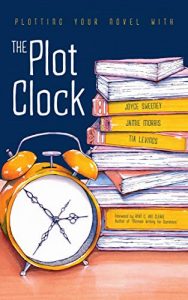
For ten years, I’ve been helping writers extricate themselves from exactly that hairy spot—using a process called the Plot Clock. A virtual AAA road map of a narrative, the Plot Clock shows writers how to organize story events to get their characters to make the changes needed to fulfill their story’s purpose.
As Gail Shepherd, author of THE TRUE HISTORY OF LYNDIE B. HAWKINS(Penguin), says, If you want to nail story structure, there’s no better method than the Plot Clock—it gives you a visual map to represent the arc of your story and keep you on track.
Now, I and my co-authors Joyce Sweeney and Tia Levingshave finally written the Plot Clock book. So, if your story is stuck and spinning its wheels, forget AAA. Just call Amazon! Tell ’em to send a literary tow truck—fully loaded with a copy of PLOTTING YOUR NOVEL WITH THE PLOT CLOCK!
SOMETIMES, I JUST WANT to give a tarot archetype a good shake! The Knight of Pentacles, for example. Sure, he’s got plenty of good qualities: He’s hard working, loyal, and reliable. You can trust him with your last dollar, which he’ll prudently invest for you.
But he’s so freakin’ cautious! Before taking any action, he’ll weigh every possible pro and con—leading you to ask, “How much research is really necessary before you just go to Best Buy and replace the microwave that blew up TWO MONTHS AGO?” (Did I mention I was married to this guy?)
His caution extends to writing, too. Under his influence, we might believe we should know exactly what we’re going to say before we commit so much as a word to the page. Which, for sure, will stop us dead in our writing tracks. For this reason, the Knight of Pentacles might well be the Patron Saint of Writer’s Block.
Tarot writing prompt
Making a list, checking it twice: Simple as it sounds, list-making is a stealth move that will help you slip beyond this Knight’s too-careful sway. Put aside ten minutes and pick a topic. You might decide to create a shopping list for yourself or a character, or a list of your favorite girls’ names, or of a frenemy’s worst traits. How about a list of places you’ve lived? Or places you’d like to visit? Cats in your life? Street names in your subdivision? Super heroes? Planets (actual or fictional) most likely to support life?
Whatever you choose, the trick to truly inspired list-making is to push your brain past the obvious (hello, Mr. Knight?), which is what it will dole out at first. Do this by committing to a larger-than-reasonable number of items. So, once you’ve picked a topic, number your page from 1-50 and go! Then, when you’ve got your fifty, choose the most intriguing item from your list. Set a timer for five minutes and take off from that idea, writing as fast as you can. When the timer dings, pick another item and begin again.
Believe me, when you look up from this exercise, that stodgy Knight of Pentacles will be nowhere in sight. (Who knows? Maybe he’ll have finally ambled off to Best Buy!)
Novel-writing inspiration
The Poetry Foundation has a great little article by Michael McGriffon using list-making to rev your writing engine. It includes a two-part writing exercise that can help you dig deep while you’re moving fast!
IT WAS SO FREAKIN’ COLD that day in the tiny Central Florida town of Oviedo that the anachronistic Oviedo chickens had huddled under the frost-bitten azaleas bordering the Ace Hardware parking lot and hunched in feathery clumps between oak tree roots.
A week before, I’d run a creativity workshop based on Julia Cameron’s ideas. Inspired by my own facilitation, I took myself on a combination Weekly Walk and Artist Date—to do just what I’d asked my workshop participants to do: walk, then jot down what I saw.
So, first there were the chickens.
After leaving them behind, I turned up Central Ave. and crossed a small bit of bridge (an asphalt hump, really, covering a concrete pipe through which a thread of brown water passed). There, I shared cold-weather pleasantries with a young black man on a bicycle, who paused—gloved, parka-ed, and balaclava-ed—to watch the trickle of rusty water lap against the rocks lining its narrow bed.
Bidding the young man goodbye, I wandered across North Central and through the sparse grove of oaks that separates Central from Geneva Drive. There, I came upon the white block Fountainhead Missionary Church with its thick panes of stained glass. How would the light inside the sanctuary appear after traveling through those windows? I wondered. Would it be purple, like sacramental wine? Bottle green, like old hope? Deep sapphire, like a promise placed on a loved one’s hand?
Since there was no one around to let me in to see, I crossed Broadway to Blue Moon Antiques and Consignments. There, I overheard a nicely-suited, middle-aged guy telling the owner that his nineteen-year-old son, newly released from prison, had stolen, then hocked or sold, three boxes of his prized 1960s-1970s record albums, and that he was now touring Oviedo-area pawn shops, antique malls, and thrift stores trying to recover them. But, the store owner told him, shaking her head, none had made their way to the Blue Moon.
I stepped out of the shop just as the man eased his Taurus wagon slowly down the Blue Moon driveway and headed east for Chuluota.
From the wooden stoop, I waved at his rear-view … just in case he looked back.
Tarot writing prompts
The Eight of Cups is a wanderer. Seeking emotional fulfillment, she leave her past behind. She is guided on her quest by her imagination, by the possibilities that beckon from around the next curve in the road. And if she doesn’t find what she’s looking for, there? Welp, she’ll just keep on walking.
Here are three writing prompts inspired by the Eight of Cups.
PROMPT ONE: Write a series of three scenes about a character who sets off seeking something to fill an emotional gap in her life.
Scene 1: Demonstrate your character’s dissatisfaction with a specific situation—then show her walking out the (perhaps metaphorical) door in pursuit of something better.
Scene 2: Make sure to let the reader see what guides your character’s feet along her path. How does she decide where to go?
Scene 3: She’s discovered something! What is it? How did she stumble upon it? And does it really fulfill her unmet needs?
PROMPT TWO: If, on the other hand, like the “record salesman’s” father, your character is missing something specific—due to theft or carelessness—write a scene in which she traverses her neighborhood, trying to find what she’s lost.
PROMPT THREE: Or, perhaps, like me that day, she’s just wandering hoping something interesting will turn up. If so, what does turn up? And how does it change her life?
This site uses "Cookies" to make this site simpler and give you the best experience possible. By continuing to use this site, you agree to our Privacy Policy.

 As my music partner, Elli, and I wrote songs with these YouTube and Instagram stars, I felt myself getting immersed in their world: a world where your worth depends solely on the numbers of likes and followers on your socials. It got me thinking: What if this world was exacerbated further? What if the numbers on your socials meant life or death? That’s how the idea for my latest book was born. It’s called “Influencer.”