Posts Tagged ‘novel writing’

Book Writers’ Coach

Why am I a book writing coach? Great question! Over the last ten years, I’ve coached writers of all types. New writers, short story writers, dissertation and thesis writers, hobbyists and journalists. But after a decade of working with a myriad of different writers, I’ve found my greatest joy as a book writers’ coach.

red book cover for book writers' coach Jamie MorrisFolks who commit to writing a book are a different breed. They’re tenacious (and sometimes hard-headed, lol).

They see the long view. They know their actions today (and tomorrow, and the next day/week/year) create their future: If they keep writing, they’ll be authors.

Me? I want to be along for that ride. Sure, there will be ups and downs. (If it were easy, everyone would write a book, right?) So when I agree to become a book writer’s coach, I’m declaring myself in it with you for the long haul.

I’ll be there to remind you about your goals, sure! But more than that, I’ll listen to your ideas and help you develop them in ways that (almost magically) transform your book into something more than you ever imagined it could be! (Believe me, I have a track record for doing just this!)

I’ll guide you to be more efficient when you need to get something—chapter, outline, query letter—done. But I’ll also encourage you to explore enticing paths that may make your work both richer for you as a writer and deeper and more meaningful for your eventual readers.

So, why am I a book writers’ coach? Because I consider it a gift and an honor to help creative people—you!—accomplish the huge task of turning your dream into a book.

It’s possible. It’s hard. It’s worthwhile. And you don’t have to do it alone.

Gearing up to write a book? A chat with a top book writers’ coach might help!

As a book writers’ coach, I have tricks of the trade to share! Book writers' coach Jamie Morris Schedule a free initial consultation with me. And also check out THE WRITER mag article Should I Hire a Writing Coach.” 

How to Write a Mystery: 10 Tips

Writing a mystery is complicated, no doubt! But, since mysteries are my favorite type of fiction, I thought it would be a fun challenge to narrow down my thoughts about how to write them effectively. The following 10 tips will help you understand how to write a mystery novel and create suspense on the page. a light shines on a closed book beneath the word "investigation." how to write a mystery

Since two heads are better than one, when considering such a complex topic, I called my award-winning mystery writer pal Elizabeth Sims. She generously agreed to allow me to pick her brilliant mystery-writing brain.

Together, Elizabeth and I settled on the following 10  tips for writing a mystery. We hope they help you find your way through the tricksy woods of your story!

10 tips for writing a mystery

How to write a mystery: sub-genres and outlines

1) PICK A SUB-GENRE: There are many mystery sub-genres. These include cozy mystery, hard-boiled detective fiction, and police procedurals, to name just a few. Job 1? choose your sub-genre and familiarize yourself with the conventions of that style.

2) READ WIDELY: Once you’ve chosen your sub-genre, read 100 (really: 100!) books of that type. While this might seem like overkill (and maybe slightly insane), reading very (VERY) widely in your genre is the single best way to absorb the rhythms of the category.

Plotting your novel with the plot clock book cover helps you know how to write a mystery3) MAP OUT YOUR STORY: Depending on your sub-genre, your story is likely to be quite intricate and complex. Allow yourself time to identify the various twists and turns of your plot. Mystery writers, even more than other writers, benefit from creating solid outlines before starting to write.

Character arcs, subplot, stakes, and settings

4) GIVE YOUR DETECTIVE PROBLEMS: Allow your main character to struggle in their personal life while trying to solve the crime. Their struggles should force them to make a much-needed inner change. This change is as satisfying to the reader as seeing the mystery solved.

5) RAISE THE STAKES! You might think the very fact of an unsolved murder provides enough motivation for the investigating detective. But acctually, stakes-wise, you’ll want your detective to have some skin in the game. Whether they’re threatened with a demotion if they don’t resolve the mystery or they are actually suspects in the case themselves, raise the stakes by giving your main character an urgent  reason to apprehend the murderer.

6) CREATE SUBPLOTS: Mysteries are meant to be, well, mysterious. If you’re driving your story down an unswerving path, your reader won’t enjoy the ride as much as if you add twists and turns—some of which can be provided by a subplot.

Perhaps you can develop one of your main character’s difficulties (above) enough that it distracts that them from solving the crime at hand. If that distraction puts the investigation in jeopardy, you’ve added an extra dollop of suspense into the subplot mix.

7) KNOW YOUR SETTING: Set your mystery in a location (or era) that you know well. Perhaps you’ve got a deep interest in Colonial Africa. Or lived in Boston in the 1980s. Wherever you set your story, be sure you know enough about it to create a faithful and familiar world for readers.

Also, involve your detective directly in that world. Perhaps they’re an investigative reporter in a small town in Alabama or a political protester in Berlin. A main character who’s actively engaged in your mystery’s location adds depth and interest to your work.

Red herrings, reversals, and reveals in your mystery

8) ESTABLISH RED HERRINGS: Red herrings are clues or information that mislead both the detective and the reader. Use them to create suspense by misdirecting the course of the investigation.

9) NAME CHARACTERS CAREFULLY: Don’t give your characters names that signal to the reader where they fall on the good-guy/bad-guy spectrum. Creating “dark” names for dark characters limits your ability to surprise your readers with a character’s unpredictable behavior.

SPOILER ALERT: Think Snape in the Harry Potter series: Learning his dark, nasty name, readers expect him to be a real baddy. But, in fact, he’s a much more sympathetic character than we could ever have imagined. Great work, J. K. Rowling, misleading readers  with a well-considered character name!

10) ADD SURPRISES TO YOUR FINAL SCENES: Twisty endings are appropriate—and necessary—in such a twisty genre. When thinking about how to write your mystery, be sure to leave some surprising reveals or reversals for the last act. You might resolve a red herring or conclude a subplot in an unforeseen way. Whatever you do (“Luke, I’m your father”!), add something unexpected to the (pre-)climactic moments of your mystery.

Writing a mystery in a moral universe

In a way, a mystery novel describes a moral universe. Someone has done something wrong—and we want to see them pay. While you may choose not to bring your antagonist to justice, do your best to create a conclusive ending of some sort.

We’re living in uneasy times. If you can restore order to even a fictional corner of the world, without compromising your artistic vision, I, for one, will be grateful.

Resources to help you write a mystery

Of course, these tips are just the—ahem—tip of the iceberg when it comes to learning to write a successful mystery novel. A search on YouTube, Amazon, or Google will yield another gazillion helpful hints. The resources that follow are particular favorites of mine. Your mileage may vary.

START HERE: When you’re considering writing a mystery—or any other book, for that matter—Elizabeth Sims’s YOU’VE GOT A BOOK IN YOU is a great place to start. Subtitled “A Stress-Free Guide to Writing the Book of Your Dreams,” Sims’s book has garnered tons of well-deserved love—especially from newer book writers.

Plot is central to writing a good mystery. My own book, PLOTTING YOUR NOVEL WITH THE PLOT CLOCK, is a small-but-mighty-tome I wrote with two fabulous co-authors. Its simple—not simplistic—approach to plot can be a game-changer. (Learn more about the Plot Clock!)

OTHER GOOD BOOKS: Larry Beinhart’s HOW TO WRITE A MYSTERY, Patricia Highsmith’s PLOTTING AND WRITING SUSPENSE FICTION, and P.D. James’s TALKING ABOUT DETECTIVE FICTION are just three of many other helpful titles for writers who want to know how to write a mystery.

ORGANIZATIONS: Mystery Writers of America is a wonderful organization. It hosts regional and national mystery writing conferences and provides many other valuable resources for members. Sisters in Crime provides support for women crime writers. And the site The Cozy Mystery Library has virtual shelves full of helpful links for those writing cozies.

Ready to write that mystery? A chat with a top writing coach could help you get started!

Discover how to get your mystery novel off to a great start. Jamie Morris is a mystery novel writing coach. Schedule a free initial consultation. And also take a look at this THE WRITER mag article Should I Hire a Writing Coach.” 

Writing Young Adult Fiction

If you’re writing Young Adult fiction, also known as YA, you’ve probably already created an angsty, yet sympathetic, teenage main character (MC). Teen boy against wall writing young adult fictionWhat else do you need? Well, when we’re writing Young Adult fiction, we first need to give our angsty MC a problem to solve. We’ll also want to bestow upon them a skill to develop and an inner need to resolve.

In addition, we’ll want to surround our MC with a cast of characters—teenage and otherwise—who complicate or obstruct the MC’s goals. These might include a love interest (or two, for conflict), a mentor, and a sidekick/best pal. You’re also likely to need an antagonist (who may end up being a friend) and a “precious child” (a character dear to the MC, whose vulnerability puts the MC’s goals in jeopardy).

Be sure these characters have agendas that run counter to your MC’s. These competing objectives will provide a solid field upon which your MC can play to get the win.

YA writer published and awarded!

The above ideas may seem (unbearably?) clichéd to your own inner rebellious teen. But we can always at least explore the conventions of our genre. Then, we can see what of those tried-and-true ideas will serve our own story best.

My Young Adult fiction writer client Melody Maysonet found a balance. In her now award-winning YA novel A WORK OF ART, Maysonet skillfully incorporates YA conventions into her fresh, edgy tale of an art student on the brink.Writing Young Adult fiction book cover A Work of Art

Melody writes, Jamie, Thank you for the inspiration and knowledge you bestowed on me during the writing of the first draft. Not only that, but you gave me a killer critique for my revision. I revised based on your feedback, so the manuscript that got sold reflects your amazing instincts. Thank you so much.

Writing a YA novel? I’m a young adult fiction fan—and a top writing coach. I can help!

Book coach Jamie Morris can help you writing young adult fiction Morris can help.As a lover of YA, myself, and as a professional book coach, I can help you see the path for writing a young adult novel. Schedule a free initial consultation. And check out THE WRITER mag article Should I Hire a Writing Coach.” 


King of Cups, Your Writing Coach

If Tarot’s King of Cups were your writing coach, he’d teach you to calm the troubled waters of your writing life. He rules a kingdom that is entirely fluid and in motion—and he’s had to learn how to maneuver in its emotional depths. It took him some time, but the King of Cups has matured into a person who can acknowledge his feelings without being overbalanced by them. And this is his gift to you.

King of Cups, your writing coachYou see, it’s his kingdom—of water and creativity and the unconscious—from which our dreams and our writing emerge. But when we enter his world, we must be prepared. Our writing can take us far from known shores. It can bring us into waters so deep we get the bends. But, whether we are writing memoir or fiction, those depths are where we are most likely to find pearls of great worth.

Writing coaching advice from the King of Cups: “B” is for “ballast”

So how do we make the best use of the King of Cups’ advice? Take on ballast! “Ballast” is defined as something that gives stability—certainly helpful when we’re about to tug on our scuba gear and slip backwards into the wild waters of our creativity.

One way to stabilize ourselves is to take on a daily writing practice. Our writing practice might look like Julia Cameron’s Morning Pages or Natalie Goldberg’s writing practice. We might use a journaling app or keep a quiet blog. However we choose to do it, writing daily can keep our ship steady as we navigate difficult shipping lanes.

The King of Cups might also suggest we have regular conversations on dry land. We can meet with other writers, sharing advice as well as telling harrowing tales of the tsunamis we’ve survived! We might also seek out a counselor or a 12-step or other supportive group. Sharing our experiences with others can help us find balance while we’re deeply engaged creating an imagined or remembered life on the page.

From his sea-tossed throne, our writing coach the King of Cups reminds us that the more we commit to our literary work, the more likely we are to be pitched about by internal squalls. He’d like us to prepare for those squalls—by having plenty of ballast at hand.

Would you like to discuss your writing process with a top writing coach?

I’ve worked with many deep-diving writers. I’d love to hear about your work and see if I can help. Jamie Morris Writing CoachI invite you to schedule a free consultation. You might also read Should I Hire a Writing Coach” in THE WRITER magazine.

Thanks to U.S. Games Systems, Inc. for kind permission to use the image of the King of Cups from the DREAMING WAY TAROT.

Writing a Novel Fast(er): 10 Tips!

10 Tips for Writing a Novel Fast(er)

Writing a novel is a long game, no way around it. But I’ve Jamie Morris Writing Coachhelped many writers get to THE END, and I know there are ways to shorten the curve. I’ve listed my favorite get-your-novel-written approaches below. From first concept to first draft, these tips will help writers get their novels onto the page.

Fast(er) novel-writing strategies

1) Think “draft,” not “polished manuscript.” We read published novels and see that they proceed from cleanly edited start to well-honed end. So it’s natural to imagine our book-writing process should follow suit. We decide to create a polished novel—complete with sharp prose, fully developed characters, and beautiful images—as we go.

But it’s actually much more efficient to write our novels as a series of tdrafts. On the first pass of your story, go rough. Next draft, revise to fulfill what’s missing from the first. And save the polishing for your final version.

2) Save editing for later. Rather than stopping to tweak grammar or manage a particular sentence, keep the words flowing! It’s important to get your story DOWN, and broad strokes will help you do that. Don’t want to risk losing your story-telling traction for an errant period or awkward bit of description. Come back and fine-tune later.

3) Make margin notes while writing your novel. Rather than editing as you go, add margin notes to your document. When you revise, these will act as a sort of breadcrumb trail, reminding you what you thought might improve a scene, character, or plot thread. It’s quicker—and less of a creative interruption—to make a general note to consider later than to halt your momentum to wrangle a specific passage.

4) 1000 words a day will get you there—fast! Does 1000 words seem like a lot? Too much?! What if I remind you that 1000 words is actually only four lit-industry standard pages? Does that make it seem more doable? 1000 words a day (even with weekends off), will net you a complete draft fast!

Map it out to write your novel faster

5) Outline your novel. Know where you’re taking your characters before you pack their bags and hit the draft-writing road. Just clarifying your major plot points will help. However, the more detailed your outline, the more quickly you’ll be able to complete your initial draft.

Some writers fear outlining will make their story feel contrived. My work with novelists has shown otherwise. The outlining process can be just as creative and deep as any other aspect of writing your novel.

Plotting your novel with the plot clock book

5a) “I’m a pantser,” you say? Okay! Go ahead; pants your way through your first draft. Before revising, though, outline what you have. That should help you see if you need to create better flow or more suspense or stronger character arcs.

My book, PLOTTING YOUR NOVEL WITH THE PLOT CLOCK, is a quick read and explains a basic approach to outlining your novel.

6) Hop around! Take the advice “Pick Only Ripe Apples,” from LIFE, PAINT, and PASSION, by Michele Cassou and Stewart Cubley:

To keep your process flowing, to feel the enjoyment of creation, you first need to go where it is easy. Easy means ripe. Go where you are attracted…. While you work on the part that is easy, other parts will mature in you, and they will be ready and waiting. You move step by step, from the easiest to the easiest. It is never tedious or tiring because there is no need to force anything. Depth resides more in surrendering to spontaneity than in hardworking struggle.

Apply this to writing your novel. Follow your instincts. No need to pick up where you left off. And if you’ve created an outline, you’ll never get lost in the dark woods of your story!

Set limits

7) Limit yourself to a single point of view. Sure, there are times when one point of view (POV) won’t get the job done. But a single POV story can be quite compelling—and surprisingly complex. Mystery phenom Tana French writes many of her best-selling novels from a single point of view—IN THE WOODS, for example. Her psychologically rich books have won critical and popular acclaim.

Multiple POVs require multiple character arcs—which is both complicated and time consuming. Want to fast-track your novel? Try focusing on a single POV character.

8) Write for just one hour. It can be a huge accomplishment to carve out time to write. And I’m suggesting you stop after just sixty measly minutes?

Yup. I am. Well-regarded artist Nicholas Wilton suggests we limit our creative sessions to an hour. That’s when we’re most effective, he says. I find this to be true. As I enter the second hour of painting or writing, I get circular in my thinking and tight in my expression—neither of which is conducive to making fresh and exciting work.

9) Walk daily. Many writers swear by their daily walks. Why? Walking gives us an oxygen boost. Also, a change of scenery can enliven our brains. And taking a walk can help us solve story problems. We set out for a stroll feeling stuck, only to return with the solution in hand.

10) Write your novel in November. “NaNoWriMo,” short for National Novel Writing Month, is a month-long, nationwide novel-writing fest that takes place every November! Participation is free—and knowing you’re part of a coast-to-coast cadre of novel writers will fill your tank.

For more ideas, check out these two articles: “How to Write a Novel” and “Plotting Your Novel: 5 Fabulous Tips.”

Would you like to discuss your book with a top writing coach?

I’m available to be your professional writing coach. Schedule your free consultation and check out Should I Hire a Writing Coach” in THE WRITER magazine.

How a Book Writing Coach Critiques Your Book

Jamie Morris Writing CoachWhether your book writing coach calls it a “critique,” a “review,” or an “evaluation,” they mean the same thing. Your coach will read your work and give you their professional feedback on essential elements of your manuscript.

But wait! Does that sound scary?

For many writers, the idea of a critique—no matter what term we use to describe it—can be anxiety-producing. If you’re worried about sharing your work with a professional writing coach, here’s something to keep in mind. Your coach is not assessing your work to judge you, but to help you achieve your writing goals! As part of your book-writing team, your writing coach has only one objective—to support you.

To support you effectively, when you hire a book coach, the first thing they’ll want to do is evaluate your book-in-progress. It doesn’t matter how far along your book may be. You might only have an idea for a book. If so, that’s fine! In that case, your book coach will work with you to develop an outline or a synopsis from that initial concept. Whatever you have in hand—an idea, an outline, a partial draft, or just a few chapters—your new coach will want to get a feel for where you are in your book-writing process.

This initial critique will allow them to give you feedback on what’s working and what needs further thought. And it’s a great way to get the writing-coaching ball rolling in the right direction.

What your book writing coach looks for …

Writing a novel?

Specifically, if you’re writing a novel, your novel writing coach will probably ask you for a synopsis, a character list, a rough plot outline, and a sample chapter or two. From these materials, your coach will be able to review your story for significant story elements. They will want to know, is your pacing tight and suspenseful? Do your characters’ voices support the general tone of your story? Is your main character facing enough of a challenge to create their all-important internal arc?

You and your coach will discuss these and other aspects of your novel-writing craft after their review of your materials. From there, you’ll create a road map of the path you’ll take as you complete your novel.

Writing a memoir?

While writing a memoir is surprisingly similar to writing a novel in some respects, your memoir coach will first want to consider the scope of your story and its focus.

Memoir vs. autobiography: You see, a memoir differs from an autobiography in two ways. An autobiography considers the entirety of a person’s life—from birth up to time of writing. It will be written chronologically, start to finish, and may well include quite a bit of information about the writer’s parents and other family members.

A memoir, on the other hand, considers either a limited period in a writer’s life or focuses on a single aspect of their life over a longer period of time. Because of these limits, a memoir might be effectively written in any one of a number of non-chronological ways.

Therefore, when they are assessing your memoir concept, your writing coach will want to know the timeline you’ve planned to develop: For instance, where does your story start and stop? Does it cover just your high school years? Your first ten years of sobriety? Or the six months you were in rehab after your accident?

They’ll also be interested in understanding how you are “framing” your memoir. For example, are you focusing your story on a specific event—like the summer you were a ball girl for your local AA baseball team? Or are you writing about a trait from childhood that you overcame in adulthood—like a debilitating fear of dogs?! Your memoir’s scope and focus will determine the outline, so that’s where your coach will start their critique.

Writing a nonfiction book?

If you’re writing a nonfiction book—especially an instructional book, like a self-help or how-to title—a chapter by chapter outline is the most efficient way to convey the organization of your ideas to your nonfiction book coach. This outline will guide you in your drafting process—and it can also form the basis of a nonfiction book proposal, if you choose to create one.

Add in a sample chapter or two, and your nonfiction writing coach will be able to “hear” how you’re addressing your audience. From there, you and your coach are well on your way to tweaking what needs to be tweaked and getting a good, solid draft—or book proposal—done.

Accountability partner + cheerleader!

In addition to reading and responding to your writing, your coach will act as your accountability partner, creating a regular meeting schedule and offering assignments to keep your book moving forward. Your writing coach will also cheer you up when you feel discouraged and cheer you on as you make strides towards completing the very best book you can write!

If you need support in finding a book coach, check out this article on how to find a writing coach. Also, check out Should I Hire a Writing Coachin THE WRITER magazine. If you are considering hiring a book coach, I’d love to invite you to schedule a free writing consultation. Let’s see how I can help!

Plotting Your Novel: Five Fabulous Tips!

Plotting your novel can be confusing!

I compiled these five fabulous tips to help when you’re plotting your novel. I hope they’ll provide a guidance system to help you navigate your story. You might find yourself asking questions like these.

  • Where do I start my story for greatest impact?
  • What events will force my main character to undergo the change they so desperately need to make?
  • How do I construct stakes that are high enough to keep my main character engaged with their quest all the way to the end?

If you, like me, need some help to deal effectively with these and other pressing plot questions, read on. I’ve compiled a short list of tips, approaches, and resources that demonstrate ways to successfully traverse the rough terrain you and your main character must travel to create a compelling tale.

Fabulous novel-plotting tip #1: Explore plotting methods.

Fortunately, for those of us who are writing novels or memoirs—basically, anything that tells a story and develops a character arc—many writers have gone before us and have generously blazed a trail through the wild woods of plot for us to follow.

So which of these many plotting methods is the best?

When I immersed myself in the mysteries of plot, I read book after book on the subject. But I always felt I was missing something. Then Joyce Sweeney and I started developing the plot clock—and everything fell into place! Suddenly, I saw how exactly how plot can create a character arc—and what steps to take to make that happen.

For years, Joyce and I taught the plot clock at workshops, writing conferences, and to our clients one-on-one.

Now, we’ve written the book! How to plot your novelAs you’re browsing Amazon for books on plot, check out our PLOTTING YOUR NOVEL WITH THE PLOT CLOCK. It’s short—just seventy pages! And yet it explains how to accomplish the two most important tasks you face when writing a novel or memoir. The first is: relating a dynamic set of story events. And second: making your character change in response to those events.
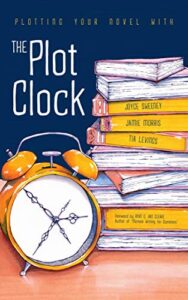
Of course, this is just the method that works best for my brain. You might love any one of a number of other more linear takes on plot, like SAVE THE CAT WRITES A NOVEL by Jessica Brody. Or you might enjoy diving really deep in story theory with a book like THE WRITER’S JOURNEY by Christopher Vogler.

Take the time to find what plotting approach works best for you—because once you find what fits, that method will be your trusted guide through the rest of your story-writing journey.

Fabulous novel-plotting tip #2: Start with the basics.

Here are five quick, handy reference points to help you think about how to get your story started and where you’re going to take it. Considering your plot in these simple terms allows you to see if your basic idea has enough oomph to carry the story to the finish line.

Once upon a time there was … (Describe your main character.)

Every day … (This is a glimpse at your main character’s “ordinary world,” before the inciting incident changes their life.)

One day … (Aha! Inciting incident!!)

Because of that … (Here, we see how the main character responds to the inciting incident—and we establish stakes [see Fabulous Novel-Plotting Tip #5, below] that propel them forward into the main events of their story.)

Until finally … (This actually takes you past most of what happens after your character commits to their story—their trials and challenges; their low point; their lessons learned—and brings them to the climax, the battle to end all battles, the inevitable high point of your tale!)

Fabulous novel-plotting tip #3: Let the C’s catapult your plot.

Raindance, an independent film festival and film school that operates in major cities, including London, Los Angeles, New York, Vancouver, Toronto, Montreal, Budapest, Berlin and Brussels, offers up a helpful article on the “The Three C’s of Plot (and how they help you get through Act II).”

The “three C’s” of this approach are conflict, choice, and consequence. Having a handle on these major story drivers will assure that your plot has the traction it needs to keep readers deeply engaged.

Further, in the above-mentioned article, writer Jurgen Wolff says, “{While] you can use these [the three C’s] to develop your main plot … they are equally useful in constructing the smaller components of your story-–the individual scenes. This is especially true in helping you construct the hardest part of any story, the middle, or Act II.”

Learn about this concept at the Raindance site.

Fabulous novel-plotting tip #4: “Yes, and …”

This improv-acting tenet encourages your characters to engage dynamically with the events of their plot. Every time the plot makes your character an “offer,” be sure she “accepts” that offer (says “Yes” to it), and then adds to the situation (or, better still, complicates it!) by adding an “and …”

For example, let’s say your character is walking down a crowded street and notices someone running from a store, having just robbed it. In improv, we’d call this an “offer.” In other words, the story has brought something to your character’s attention that she can act upon. Taking action in response to the “offer” is your character’s way of saying “Yes, and …”

Rather than allowing your character to just ignore the commotion—which can slow the story and make plotting more difficult—consistently require she make a “Yes, and” response to whatever happens in her story. In this case, she might give chase. Alternatively, she could rush into the store to try to help anyone who was injured in the incident—or she could rush into the store to take advantage of the confusion and steal something herself!

In all of these examples, your character’s active response to a situation allows increasingly complex interactions with other characters to unfold. These interactions will drive her character arc and her plot forward.

When you’re writing your first draft, this technique keeps you from stalling out in the shallow waters of character ennui and unwillingness. Once you’ve “Yes, and-ed” your way through the entire plot, you can always revise to rein in excessive reactions on the part of your main character.

To learn more about improv and how “Yes-and” creates lively story-telling, I suggest YES, AND: How Improvisation Reverses “No, But” Thinking and Improves Creativity and Collaboration—Lessons from The Second City.

Fabulous novel-plotting tip #5: Create compelling stakes.

Stakes. They’re what gets your character off her duff and involved with her plot. A plot that, let’s face it, is likely to end up being a pain in her butt!

The Institute for Literature has thoughts about plot! “One of the most important questions when developing a story is ‘What is at stake for my main character?’ By this, we mean, ‘What is the cost of quitting?'”

Your character shouldn’t be able to quit the demands of their plot with few consequences! When that’s the case, you’re likely to lose your reader early on. You see, readers like to see a character struggle with conflict. So, how do you make sure you’re getting your character into a situation that has sink-or-swim urgency?

Consider my four-question “stakes-squared” approach.

Jamie’s Stakes Square: Your character is faced with a significant choice. You’ve backed her into a corner. She MUST say yes or no—because her decision will set a significant plot point into motion! To establish the stakes for the choice, ask yourself these four questions:

First question: What might your character GAIN if she says YES to the choice on offer?
Second question: What might your character LOSE if she says YES to the choice on offer?
Third question: What might your character GAIN if she says NO to the choice on offer?
Fourth question: What might your character LOSE if she says NO to the choice on offer?

Make sure all the potential outcomes create problems for your character. You’ll be well on your way to creating plot-driving stakes that will hook a reader and not let them go!

Writing a Middle Grade Novel: 10 Tips

Writing a Middle Grade novel can be an exciting adventure! But, like any adventure, it’s best to know the ground rules before you start. As a book coach, I’ve steered many Middle Grade authors through the writing process. Here are ten of the basics to keep your book squarely on the road to publication.

Word counts for Middle Grade (MG) novels

1) Know the ages of your protagonist and your audience: Middle Grade fiction is defined by the age of its protagonist and its intended audience. Your main character should be no older than twelve. They could even be as young as six or seven, if you’re writing an Early Reader. (An Early Reader book is written for new readers. It’s intended to create a bridge between picture books and chapter books.)

Since kids typically read up in age, not down, you’re writing for an audience of children between the ages of eight and twelve—with an Early Reader audience as young as five! 

2) Book lengths: Your MG story is likely to be fairly short, as far as novels go. Depending on the intended age group of your readers, your final manuscript might be as short as 10,000 words or as long as 50,000 words. If you’re writing fantasy/adventure, especially for an older MG audience, you might need 50,000 to 100,000 words—or more!

We can look to the Harry Potter fantasy series as an example of an author expanding word counts to suit her maturing audience. The first book in the series, THE PHILOSOPHER’S STONE, is 76,944 words. In that book, Harry and crew are ten years old—smack dab in the middle of MG audience age.

However, as Harry and his readers grow up, the word count of the books increase. This trend continues until, having reached the far end of the kid-lit spectrum with the final book, the Young Adult title HARRY POTTER AND THE DEATHLY HOLLOWS, we’re looking at 198,227 words.

How long should your Middle Grade chapters be?

3) Chapter lengths: Early Readers don’t really have chapters. But “chapter books,” the next level for Middle Grade readers,do. Since chapter books come in at the low end of the total word-count estimate for MG books, their chapters are proportionately short at 500-750 words. Middle Grade books, meant for more experienced readers than the chapter book audience, can have chapters of up to 2000 words—or even more, if needed.

4) Sentence and paragraph lengths and complexity: Allow your reader to enjoy the story, rather then trying to educate them with too heavy a hand. To that end, keep your sentences straightforward and fairly simple. Paragraphs, too, should be short and easy to digest. Also, no need to send your reader to a dictionary often, either. Write in language they can easily understand.

Age-appropriate content when writing a Middle Grade novel

5) Focus on the story: Focus your writing on the story and action, rather than on description or psychological insights about the characters.

6) Think G or PG rating! While your middle-grade age characters may undergo significant difficulties, convey these in a way that doesn’t dwell on the darkness, but, rather, looks to solutions. Avoid swear words and graphic discussions of sex.

7) Lighten up on emotions and psychology: Let your young characters grow and change through their actions and reactions to story events. Don’t belabor psychological insights or character introspection in the process.

8) Third person POV: Third-person point of view allows a bit of distance between character and reader. Third person makes it feel safer to read about even tough circumstances. Your MG reader will, consciously or unconsciously appreciate that distance.

9) Get good readers: Teachers and librarians of your intended audience make great beta readers! They know what’s engaging to the kids in their care. They can also help you step carefully where needed.

10) Read 200 Middle Grade novels: Those same teachers and librarians are also familiar with what’s being published currently. (In other words, what types of stories you should be guided by). Get lists of books from them and from around the internet. Read 200 recent (last three years-ish) Middle Grade novels before committing to your own story. You will be vastly more informed about what’s selling now.

Further, you’ll have developed an inner sense for the rhythms of the stories being published for your young audience. This makes your success in the  field much more likely.

Good news for a Middle Grade author

MIDDLE GRADE NOVELIST GAIL SHEPHERD has great news! She writes, Jamie, I wanted to let you know I just signed a contract with Penguin Young Readers Group/Kathy Dawson Books, for a two-book deal. Kathy made the offer based on SOUTH BY SOUTHEAST, the book you were so helpful with in workshops. I’m thrilled of course and wanted to thank you!

Shepherd is also the author of Middle Grade novel THE TRUE HISTORY OF LYNDIE B. HAWKINS.

Ready to write that Middle Grade novel? As a professional writing coach, I can help!

Jamie Morris is a professional writing coach who helps middle grade authors complete their novels. If you have questions about writing your Middle Grade novel, a free chat with me might get you on the right path.  Schedule that free consultation. And also check out THE WRITER mag article Should I Hire a Writing Coach.” 


Story Ideas for Writers

Used to be, I’d have to hunt for great story ideas.

Sometimes, I’d dig out an idea for a story from the newspaper or a conversation I heard at Starbucks. Recently, though, I haven’t even had to get out of bed to gather inspirational goodness. That’s because a couple of bloggers have been delivering fresh literary fodder to my inbox on the regular.

Here are two such story ideas. Either could blast a humdrum story out of its complacency!

1) Inventing narratives

Hip biz guru Seth Godin wrote recently about inventing narratives. He said, That story in your head? It’s invented. It has to be. It might be based on some things that actually happened…. But it can’t possibly be a complete and detailed understanding of everything.

Seth sees this creative interpretation as problematic. That’s because Seth is not a novelist! Novelists are probably especially prone to inventing narratives—and probably particularly good at it! They might tell stories about everyday occurrences, family history, or the big issues life flings at us. What type of story ideas do you have?

For instance, a novelist could make up a story to explain the behavior of someone who snatched a parking spot from her, the reasons her parents favor her sister, or why one person got a terrifying diagnosis but she did not.

Which is actually pretty awesome! (Maybe not in real life—but in our literary lives, for sure.) That’s because it’s a short trip from misinterpreting a situation to taking misguided action on it—which, in fiction, can lead to exactly the sort of trouble needed to drive our story full speed ahead!

Got a dead spot in your plot? A place where not enough is happening? Play with this idea:

  • Your main character misunderstands another person’s motivations—believing them to be acting out of malice, when that is far from the truth!
  • Even worse, your MC takes vindictive action in response to the story she’s concocted.
  • What bad stuff comes tumbling down the hill to complicate her life as a result?
  • How the heck is she going to dig herself out of this mess?

2) Alter egos

Clever tarot writer Kate at DailyTarotGirl.com has been promoting the subversive advice of her “evil twin,” Veronica, for years. As I pondered a fresh approach to story ideas for writers complicating a story I was working on, I thought about Veronica and realized the damage an alter ego could do to a plot!

Just imagine it! What if your main character had an alter ego? A persona she allowed to say, eat, or do whatever her daily persona was constrained against? That alternative personality might be braver, stronger, or kinder than she is in her regular guise. Or that other personality might be sneaky and underhanded. Or, if you’re writing a thriller, she might even be murderous!

And that’s just a start! What kinds of literary trouble might such a character generate? The story ideas seem endless—and fascinatingly, conflict-inducing-ly, complicatedly fraught!

So, that’s it for this week. Now, go forth and blow up your plot with these or any other trouble-inducing ideas. Just light the fuse and stick your fingers in your ears. After it gets over the shock, your story will thank you for it!

Writing coach

Need help with your book or thinking about hiring a writing coach? I’m available for book coaching and manuscript review! And check out Should I Hire a Writing Coach” in THE WRITER magazine.

* * *

Thank you to Llewellyn Worldwide for kind permission to use the image of the Moon card from the EVERYDAY WITCH TAROT

Giving the Wrong Character the Benefit of a Doubt: A Novel Writing Tip

Novel Writing Tip: Benefit of a Doubt

IN REAL LIFE, IT’S GREAT TO GIVE SOMEONE THE BENEFIT OF A DOUBT. (For instance, while you know Janice might be hiding your pearl necklace somewhere in her room, because she’s your best friend, you’re willing to give her the benefit of a doubt and accept her claim that she hasn’t seen it since you wore it to Sarah’s wedding.) Yes, a novel writing tip is giving people the benefit of a doubt allows them the chance for a do-over or to make amends. (You know, like sneak your pearl necklace back into your jewelry box while you’re not looking.) But unless they actually change their (bad) behavior, the amends are pretty much null, right?

I think we’ve all met that person. Heck, we may have all been that person! Sometimes, a habitual way of being—however detrimental to self or others—simply overrides the impulse to change. In that case, no matter how many benefits of a doubt they receive, some folks aren’t going to head down a better path anytime soon.

This is tough when it applies to someone close to us—in real life. But what if the recalcitrant person is a character in your novel? Well, then! You either have an excellent, if weasel-y, antagonist. Or you might have a deeply flawed protagonist. In either case, you’re in possession of literary trouble of the most excellent kind!

Here is a novel writing tip: what could that benefit of a doubt look like?

  • allowing for the possibility that she didn’t really shove that boy from the monkey bars—maybe she was just reaching out to grab the kid when he fell
  • allowing for the possibility that his hitting her was a one-time occurrence
  • allowing for the possibility that the circumstantial evidence tying her to the murder is just that: purely circumstantial
  • allowing for the possibility that he really didn’t know the gun was loaded
  • that he really, truly, honestly didn’t know that the “gift” constituted a bribe

Pick one of these—or any of the myriad other benefit-of-a-doubt-eliciting situations that would give a character one more chance to “slip out the back, Jack”—and you’ll find yourself tumbling into a veritable rat’s-nest of plot development.

You see, giving the wrong character the benefit of a doubt can ratchet up your story to such a level that your beneficent protagonist will be forced take a stand. On the other hand, if it’s your flawed protagonist who has been handed one benefit-of-a-doubt too many—received yet another several-thousand-dollar loan from her parents; gotten a pass from his boss when yet another co-worker has filed a complaint about his sexist remarks; had the accusation about yet another nasty incident at the dog park waived—then it’s clear her story is going to back her into a stakes-filled corner and keep her there until she cries “uncle!” and makes a change.

What is simply unacceptable behavior in real life can prove invaluable in turning up the heat in your fictional world. So, go ahead. Give that questionable character the benefit of a doubt and let the good (story-telling) times roll.

Novel Writing coach

Want to know how to write a novel? I’m available for book coaching and manuscript review! And check out Should I Hire a Writing Coach” in THE WRITER magazine.

* * *

Thank you to Llewellyn Worldwide for kind permission to use the image of the Seven of Swords from the ANNA.K TAROT.

Posted in News, Notes & Quotes | Comments Off on Giving the Wrong Character the Benefit of a Doubt: A Novel Writing Tip

1 2 3 4

Copyright ©2026 Jamie Morris LLC| Contact | Privacy Policies | Terms & Conditions