Writer's Blog: Tips and Inspiration

How to Choose a Creative Writing Coach

creative writing coachingA creative writing coach is a professional who provides guidance, feedback, and support to help writers develop their craft and achieve their writing goals.

Are you looking to hire a writing coach who is the perfect fit? I hear you! Deciding to work with a coach—whether you’re looking for a fiction writing coach, a nonfiction writing coach, or a memoir writing coach—is a big step.

An experienced coach is able to work with writers at all stages of their journey, from beginners to seasoned writers. In my experience, the coach/writer relationship is a personal one. Not only do you need a coach who knows her stuff (of course!), but you want a coach who inspires and supports you.

From my years working as a writing coach, I have plenty of tips to help you know how to find just the right creative writing coach for you—as well as what to expect from that coaching relationship once you and your coach get into the nitty-gritty.

How to choose a creative writing coach

  1. Know your writing goals: Before you start your search, think about what you want to achieve from coaching. Do you want to develop your unique voice, find your personal style, complete your manuscript, discover the right genre for you and the ideal audience for your work—or all of that?!
  2. Research writing coaches: There are many writing coaches out there. Search for book coaches online, through writing associations, or by asking for referrals from other writers. (But remember, while each coach may be great in their own way, not all will be a fit for your needs.)
  3. Review writing coaches’ credentials: On their websites, writing coaches typically present their credentials—including their education and coaching experience. They might also share testimonials from writers who have used their services.
  4. Interview potential coaches: Schedule a consultation with potential coaches to discuss your goals and their coaching philosophy and style. During that meeting, notice if they give you their careful attention and respond to you openly and with a positive vibe.
  5. Sample a session with your top picks: Many coaches will offer some sort of a trial session. This will give you a hands-on chance to see if their coaching style and approach work for you.

A client of mine had this to say about hiring a writing coach: We all have our writing strengths and weaknesses. A good writing coach celebrates the former and helps improve the latter—and she creates an atmosphere of acceptance.

Ultimately, working with a coach can help you become a better writer, make progress with your writing goals, and increase your chances of success as a writer.

Plotting Your Novel: Five Fabulous Tips!

Plotting your novel can be confusing!

I compiled these five fabulous tips to help when you’re plotting your novel. I hope they’ll provide a guidance system to help you navigate your story. You might find yourself asking questions like these.

  • Where do I start my story for greatest impact?
  • What events will force my main character to undergo the change they so desperately need to make?
  • How do I construct stakes that are high enough to keep my main character engaged with their quest all the way to the end?

If you, like me, need some help to deal effectively with these and other pressing plot questions, read on. I’ve compiled a short list of tips, approaches, and resources that demonstrate ways to successfully traverse the rough terrain you and your main character must travel to create a compelling tale.

Fabulous novel-plotting tip #1: Explore plotting methods.

Fortunately, for those of us who are writing novels or memoirs—basically, anything that tells a story and develops a character arc—many writers have gone before us and have generously blazed a trail through the wild woods of plot for us to follow.

So which of these many plotting methods is the best?

When I immersed myself in the mysteries of plot, I read book after book on the subject. But I always felt I was missing something. Then Joyce Sweeney and I started developing the plot clock—and everything fell into place! Suddenly, I saw how exactly how plot can create a character arc—and what steps to take to make that happen.

For years, Joyce and I taught the plot clock at workshops, writing conferences, and to our clients one-on-one.

Now, we’ve written the book! How to plot your novelAs you’re browsing Amazon for books on plot, check out our PLOTTING YOUR NOVEL WITH THE PLOT CLOCK. It’s short—just seventy pages! And yet it explains how to accomplish the two most important tasks you face when writing a novel or memoir. The first is: relating a dynamic set of story events. And second: making your character change in response to those events.
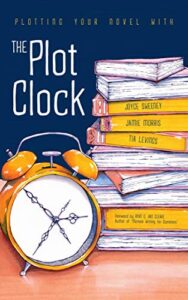
Of course, this is just the method that works best for my brain. You might love any one of a number of other more linear takes on plot, like SAVE THE CAT WRITES A NOVEL by Jessica Brody. Or you might enjoy diving really deep in story theory with a book like THE WRITER’S JOURNEY by Christopher Vogler.

Take the time to find what plotting approach works best for you—because once you find what fits, that method will be your trusted guide through the rest of your story-writing journey.

Fabulous novel-plotting tip #2: Start with the basics.

Here are five quick, handy reference points to help you think about how to get your story started and where you’re going to take it. Considering your plot in these simple terms allows you to see if your basic idea has enough oomph to carry the story to the finish line.

Once upon a time there was … (Describe your main character.)

Every day … (This is a glimpse at your main character’s “ordinary world,” before the inciting incident changes their life.)

One day … (Aha! Inciting incident!!)

Because of that … (Here, we see how the main character responds to the inciting incident—and we establish stakes [see Fabulous Novel-Plotting Tip #5, below] that propel them forward into the main events of their story.)

Until finally … (This actually takes you past most of what happens after your character commits to their story—their trials and challenges; their low point; their lessons learned—and brings them to the climax, the battle to end all battles, the inevitable high point of your tale!)

Fabulous novel-plotting tip #3: Let the C’s catapult your plot.

Raindance, an independent film festival and film school that operates in major cities, including London, Los Angeles, New York, Vancouver, Toronto, Montreal, Budapest, Berlin and Brussels, offers up a helpful article on the “The Three C’s of Plot (and how they help you get through Act II).”

The “three C’s” of this approach are conflict, choice, and consequence. Having a handle on these major story drivers will assure that your plot has the traction it needs to keep readers deeply engaged.

Further, in the above-mentioned article, writer Jurgen Wolff says, “{While] you can use these [the three C’s] to develop your main plot … they are equally useful in constructing the smaller components of your story-–the individual scenes. This is especially true in helping you construct the hardest part of any story, the middle, or Act II.”

Learn about this concept at the Raindance site.

Fabulous novel-plotting tip #4: “Yes, and …”

This improv-acting tenet encourages your characters to engage dynamically with the events of their plot. Every time the plot makes your character an “offer,” be sure she “accepts” that offer (says “Yes” to it), and then adds to the situation (or, better still, complicates it!) by adding an “and …”

For example, let’s say your character is walking down a crowded street and notices someone running from a store, having just robbed it. In improv, we’d call this an “offer.” In other words, the story has brought something to your character’s attention that she can act upon. Taking action in response to the “offer” is your character’s way of saying “Yes, and …”

Rather than allowing your character to just ignore the commotion—which can slow the story and make plotting more difficult—consistently require she make a “Yes, and” response to whatever happens in her story. In this case, she might give chase. Alternatively, she could rush into the store to try to help anyone who was injured in the incident—or she could rush into the store to take advantage of the confusion and steal something herself!

In all of these examples, your character’s active response to a situation allows increasingly complex interactions with other characters to unfold. These interactions will drive her character arc and her plot forward.

When you’re writing your first draft, this technique keeps you from stalling out in the shallow waters of character ennui and unwillingness. Once you’ve “Yes, and-ed” your way through the entire plot, you can always revise to rein in excessive reactions on the part of your main character.

To learn more about improv and how “Yes-and” creates lively story-telling, I suggest YES, AND: How Improvisation Reverses “No, But” Thinking and Improves Creativity and Collaboration—Lessons from The Second City.

Fabulous novel-plotting tip #5: Create compelling stakes.

Stakes. They’re what gets your character off her duff and involved with her plot. A plot that, let’s face it, is likely to end up being a pain in her butt!

The Institute for Literature has thoughts about plot! “One of the most important questions when developing a story is ‘What is at stake for my main character?’ By this, we mean, ‘What is the cost of quitting?'”

Your character shouldn’t be able to quit the demands of their plot with few consequences! When that’s the case, you’re likely to lose your reader early on. You see, readers like to see a character struggle with conflict. So, how do you make sure you’re getting your character into a situation that has sink-or-swim urgency?

Consider my four-question “stakes-squared” approach.

Jamie’s Stakes Square: Your character is faced with a significant choice. You’ve backed her into a corner. She MUST say yes or no—because her decision will set a significant plot point into motion! To establish the stakes for the choice, ask yourself these four questions:

First question: What might your character GAIN if she says YES to the choice on offer?
Second question: What might your character LOSE if she says YES to the choice on offer?
Third question: What might your character GAIN if she says NO to the choice on offer?
Fourth question: What might your character LOSE if she says NO to the choice on offer?

Make sure all the potential outcomes create problems for your character. You’ll be well on your way to creating plot-driving stakes that will hook a reader and not let them go!

How to Choose the Right Writing Coach

Spit-spot! Hiring a writing coach can be like inviting Mary Poppins into your writing life!

Jamie Morris Writing CoachAre you struggling to improve your writing skills? If so, you might consider hiring a writing coach to help.

Do you feel you’re not making the progress you want, no matter how much time you sink into your writing project?

Like Mary Poppins, a writing coach has a virtual magic carpet bag filled with solutions to your writing problems!

A good writing coach can help organize your writing process, galvanize your plot or story structure, and steer you in the direction of your writing goals and dreams. No matter which way the wind is blowing, I work with writers on all sorts of books and other writing projects.

Creating a blog? Writing your family history? Starting a novel? I can help! I can provide guidance as your

So, how do you go about finding the right coach? Here are some tips to get you started:

  1. Consider your goals: Before you start searching for a writing coach, it’s important to think about what you want to achieve. Do you want to develop your voice? Learn how to create a dynamic plot? Aim your writing for a specific audience? Or do you have a different goal in mind, altogether? Whatever direction you want to take your writing, be sure to look for coaches who specialize in those areas.
  2. Check credentials: When you find potential coaches, be sure to check their credentials. Look for coaches who have a background in writing, such as a degree in English or journalism, and who have experience working with writers at your skill level.
  3. Has your coach written a book about writing? Do they provide testimonials from other clients? Have any of their clients been published? Questions like these will help you determine the level of the coach’s expertise.
  4. Ask for a sampler! Many writing coaches offer a trial session or consultation to see if they will be a good fit. For example, I provide both a free initial phone consultation and a low-commitment mini-writing coaching session. Offerings like these give you a chance to see if the coach’s approach works for you—before you sign up for a long-term coaching relationship.

Since (unfortunately) writing coaches rarely float down to your front door with a spoon full of sugar and a parrot-headed umbrella, doing your research remains the best way to discover a coach who is (almost) magical in their support of you. And when you find that person? Fantastic! Working with the right coach can take you a long way to achieving your writing goals. To learn more about the writing coach relationship, check out this article, What Is a Writing Coach.

Me? I’m an expert writing coach—who may or may not have a magic tape measure up my sleeve. I coach writers at all levels of experience, in all genres. Take a look at my rates page or book a free initial consultation to see how we might work together.

Benefits of Working with a Writing Coach

Writers, the benefits of working with a writing coach can add up to the perfect equation for your success!

Wondering how working with a writing coach will benefit your writing? I hear you! The decision to work with a writing coach—whether you’re looking for a fiction writing coach, a nonfiction writing coach, or a memoir writing coach—is a big step.

When I asked my colleague Ryan G. Van Cleave, who’s the Head of Creative Writing, at Ringling College of Art and Design, why he thinks someone might take that big step, he was pretty emphatic! He said that working with a writing coach can help a writer in these very significant ways:

  • To stop floundering
  • To save years of heartbreak
  • To shorten the learning curve
  • To help develop an appropriate, effective platform
  • To create a clear direction for their writing efforts and career

All that sounds awesome, right? But what exactly does a writing coach do to help a writer achieve outcomes like that? In this article, we’ll take a peek at some of the benefits of working with a writing coach, ways to find the right coach for you, and what a writer can expect from a coaching relationship. With some luck and hard work, all these elements might just add up to a perfect formula for your success!

Benefits of working with a writing coach

There are many benefits to working with a writing coach. Here’s just a quick list of some of the most often discussed:

  1. All eyes on you: Pretty much by definition, your personal writing coach will give you and your work their undivided attention. Their professional feedback will always be tailored to you and your unique needs and goals. They have your back, always.
  2. Cheerleader: Your writing coach will support you in staying the course. Their enthusiasm for your project will encourage you to show up, even on days when doing so feels like a big stretch. (Writing coach secret: We writing coaches know that those “big stretches” are helping you grow into the writer you want to be.)
  3. “Every day, I’m getting better and better”: Yup. It’s true. When your writing coach brings all the benefits of their education and experience to you and your project, they can help you identify what you’re already doing well (congrats!) and point out where you could improve. And you will improve, because your coach will also give you precise guidance on how to make the changes to your writing that will have the most impact. Woohoo!

Wondering how to find the right writing coach?

  1. One of my clients told me this about her experience looking for a writing coach: I believe part of what makes a writing coach [a great fit] is the writer. Are you open-minded? Are you clear on your goals? Are you ready to deep dive into the work? [When you’re ready], finding the right writing coach is much like dating, trying out personalities, finding which one fits best to foster your productive and fruitful work.
  2. Of course, in addition to personality, there are practicalities to consider. I suggest you look for coaches who have a degree in writing or English (or both). You’ll also want to check out testimonials from their clients. If a coach has written a book about writing, that’s a plus!  I co-authored the innovative guide to plot for novelists and memoir writers PLOTTING YOUR NOVEL WITH THE PLOT CLOCK. And do ask a potential coach (if it’s not obvious on their website) whether any of their clients have been published.
  3. If you’re liking what you’re seeing, ask for a sampler! Many writing coaches offer a trial session or consultation to see if they will be a good fit. For example, I provide both a free initial phone consultation as well as low-commitment mini-writing coaching session. Offerings like these allow you and your potential coach to find out if you are a good fit for each other.

What can you expect from a good coaching relationship?

When Hanna Kjeldbjerg, creative director at Beaver’s Pond Press, recommends an author hire a writing coach, these are some of the reasons she cites: Authors need writing coaches for accountability, organization, and an objective eye. But more than that, writers need a partner who understands their vision for their book, who feels like a friend.

I agree. Whether you’re a more experienced writer or a newer one, I bet you aim high. You deserve a writing coach who meets you there. You want to work with someone who is not only a professional, but who is also your smart, capable writing friend. Having done the (literary!) math before, your coach should be able to help you add up all your resources so they equal your success.

Want to know more about hiring a writing coach? Check out this article about writing coaching from THE WRITER magazine or book a free consultation to discover how a writing coach can help you get your book or project off the ground and into print!

The Five Biggest Benefits of Working with a Book Coach

Your book coach knows that writing a book is an exciting—and ambitious!—undertaking. And your book coach is as enthusiastic about the challenge as you are! (It’s what we live for, honestly.) Wearing a number of different hats—editor, cheerleader, critique partner, among them—your professional book coach has the experience and know-how to help you accomplish your book-writing goals.

Time’s a-ticking: While short-form writers (like bloggers, short story writers, or business writers) might also benefit from a writing coach, when you’re writing a book-length manuscript, a coach can prove invaluable. For example: Your book coach can not only estimate how long it might take you to finish your book (less time for a how-to book than for a first novel, for instance), but she will also share shortcuts that can save you precious days or even weeks!

“How does this sound to you?”: Offering quality feedback is a big part of my job as a book coach. Often, you can find yourself too close to your project to see what’s working and what could use further development. When you ask your coach, “How does this sound to you,” you get the benefit of fresh—and sympathetic—eyes on your work. Your coach will then help you choose what additions, subtractions, or tweaks will serve your book best.

“What will help right now?”: Each time I prepare to meet with a client, I commit to showing up with an open mind and a fresh approach, asking both them and myself “what will help right now?” Writing a book is a complex process. There are many angles to consider at any one time. Determining what’s most important right now keeps your book moving forward. For example, we might decide that one of your character’s voices needs to be developed to create the tone that you’re aiming for. Or we might realize an aspect of your plot or nonfiction book outline needs to be restructured!

(True) story time: A client came to me several years ago after having an emotionally difficult experience with another coach. Her former coach approached every session with a red pen in hand, focusing almost exclusively on line edits and sentence structure. While there is certainly a time and place for that kind of focus, in this case, the writer wasn’t even halfway done with her first rough draft.

Unfortunately, that book coach’s style left the client going in circles—and often in tears! As I wrote in this post about writing coaches, a good coach is always on the writer’s side. They work with the writer, rather than trying to squeeze the writer into a box that doesn’t fit. Congrats, however, to that writer for trying again. She became my client and we set to work to figure out what she and her book needed right then. After that, she was able to work steadily and effectively and complete her manuscript.

Happy ending: That client now has an agent and a contract with a publisher for her completed memoir.

Here is brief summary of a few of the many benefits of working with a book coach:

  1. Provides one-on-one support: A book coach takes the time to learn exactly where you are in your book-writing journey. She always personalizes her feedback and guidance so it suits your unique needs and goals.
  2. Is reliable: Working with a book coach typically involves a combination of individual sessions, assignments, and ongoing professional support. Your coach shows up to meetings prepared, interested, and on time, ready to give you her undivided attention and best advice.
  3. Invites accountability: The book-coaching relationship relies on this old adage: Two (well-prepared) heads are better than one! Because your book coach arrives prepped and primed, you’ll be motivated to do the same. You’ll feel encouraged to complete the writing tasks you’ve committed to, which, in turn, will move your book-writing process along more quickly and consistently.
  4. Motivates: For all the reasons listed above, you’ll most likely find that working with a coach keeps you motivated and inspired. Of course, there are times when writing a book can be tough going. But your coach will be there every step of the way; she’s ready and able to assist you over or around any blocks that might arise.
  5. Helps you become a better writer: Not only will your book coach help you complete your manuscript (a huge win!), but she will also help you find ways to improve your writing chops along the way. This means that when you type “THE END” you’ll be a better writer than when you faced that blank screen for the first time.

And that’s a win you can take down the field for another goal.

Want to know more about hiring a book coach? Check out this article about writing coaching from THE WRITER magazine. Learn how to find a writing coach by reading this article. Or book a free consultation to learn how a writing coach can help you get your book or project off the ground and into print!

Posted in News, Notes & Quotes | Comments Off on The Five Biggest Benefits of Working with a Book Coach

Writing a Middle Grade Novel: 10 Tips

Writing a Middle Grade novel can be an exciting adventure! But, like any adventure, it’s best to know the ground rules before you start. As a book coach, I’ve steered many Middle Grade authors through the writing process. Here are ten of the basics to keep your book squarely on the road to publication.

Word counts for Middle Grade (MG) novels

1) Know the ages of your protagonist and your audience: Middle Grade fiction is defined by the age of its protagonist and its intended audience. Your main character should be no older than twelve. They could even be as young as six or seven, if you’re writing an Early Reader. (An Early Reader book is written for new readers. It’s intended to create a bridge between picture books and chapter books.)

Since kids typically read up in age, not down, you’re writing for an audience of children between the ages of eight and twelve—with an Early Reader audience as young as five! 

2) Book lengths: Your MG story is likely to be fairly short, as far as novels go. Depending on the intended age group of your readers, your final manuscript might be as short as 10,000 words or as long as 50,000 words. If you’re writing fantasy/adventure, especially for an older MG audience, you might need 50,000 to 100,000 words—or more!

We can look to the Harry Potter fantasy series as an example of an author expanding word counts to suit her maturing audience. The first book in the series, THE PHILOSOPHER’S STONE, is 76,944 words. In that book, Harry and crew are ten years old—smack dab in the middle of MG audience age.

However, as Harry and his readers grow up, the word count of the books increase. This trend continues until, having reached the far end of the kid-lit spectrum with the final book, the Young Adult title HARRY POTTER AND THE DEATHLY HOLLOWS, we’re looking at 198,227 words.

How long should your Middle Grade chapters be?

3) Chapter lengths: Early Readers don’t really have chapters. But “chapter books,” the next level for Middle Grade readers,do. Since chapter books come in at the low end of the total word-count estimate for MG books, their chapters are proportionately short at 500-750 words. Middle Grade books, meant for more experienced readers than the chapter book audience, can have chapters of up to 2000 words—or even more, if needed.

4) Sentence and paragraph lengths and complexity: Allow your reader to enjoy the story, rather then trying to educate them with too heavy a hand. To that end, keep your sentences straightforward and fairly simple. Paragraphs, too, should be short and easy to digest. Also, no need to send your reader to a dictionary often, either. Write in language they can easily understand.

Age-appropriate content when writing a Middle Grade novel

5) Focus on the story: Focus your writing on the story and action, rather than on description or psychological insights about the characters.

6) Think G or PG rating! While your middle-grade age characters may undergo significant difficulties, convey these in a way that doesn’t dwell on the darkness, but, rather, looks to solutions. Avoid swear words and graphic discussions of sex.

7) Lighten up on emotions and psychology: Let your young characters grow and change through their actions and reactions to story events. Don’t belabor psychological insights or character introspection in the process.

8) Third person POV: Third-person point of view allows a bit of distance between character and reader. Third person makes it feel safer to read about even tough circumstances. Your MG reader will, consciously or unconsciously appreciate that distance.

9) Get good readers: Teachers and librarians of your intended audience make great beta readers! They know what’s engaging to the kids in their care. They can also help you step carefully where needed.

10) Read 200 Middle Grade novels: Those same teachers and librarians are also familiar with what’s being published currently. (In other words, what types of stories you should be guided by). Get lists of books from them and from around the internet. Read 200 recent (last three years-ish) Middle Grade novels before committing to your own story. You will be vastly more informed about what’s selling now.

Further, you’ll have developed an inner sense for the rhythms of the stories being published for your young audience. This makes your success in the  field much more likely.

Good news for a Middle Grade author

MIDDLE GRADE NOVELIST GAIL SHEPHERD has great news! She writes, Jamie, I wanted to let you know I just signed a contract with Penguin Young Readers Group/Kathy Dawson Books, for a two-book deal. Kathy made the offer based on SOUTH BY SOUTHEAST, the book you were so helpful with in workshops. I’m thrilled of course and wanted to thank you!

Shepherd is also the author of Middle Grade novel THE TRUE HISTORY OF LYNDIE B. HAWKINS.

Ready to write that Middle Grade novel? As a professional writing coach, I can help!

Jamie Morris is a professional writing coach who helps middle grade authors complete their novels. If you have questions about writing your Middle Grade novel, a free chat with me might get you on the right path.  Schedule that free consultation. And also check out THE WRITER mag article Should I Hire a Writing Coach.” 


5 Writing Workshop Pitfalls

Oh, writing workshops! How we love and hate you!  A group of talented folks come together to discuss one another’s writing. What could possibly go wrong? Any one of these 5 writing workshop pitfalls, that’s what!

As a professional writing coach, I encourage my clients to join a good writing workshop. Participating in a well-run, level-appropriate workshop will add benefit to our writing coaching sessions. But a bad workshop? That’s just a waste of time. It can take some research to find the right fit—but it’s worth it. Use the lists below to increase your chances of writing workshop success.

5 common writing workshop pitfalls

1) Writers in one genre may not be well-versed in other genres. In a genre-mixed writing group this may result in less-than-helpful feedback. A horror writer might fault a women’s fiction writer for not establishing high enough stakes early on in the story, for example.

2) Often, workshop mates have widely differing opinions about what’s working and what’s not. This leaves the writer under discussion in a quandary: Which advice should they take?

3) Being a good writing workshop participant requires time. If the group is reading 25 pages of your novel-in-progress, you’re expected to read 25 pages of everyone else’s manuscripts— ongoingly. While there is much to be learned from reviewing others’ work, the amount of attention to our own work may feel like a scant payoff for the reading we do on the other writers’ behalf.

4) Sometimes a workshop member is just mean, insensitive, hurtful. Are they having a bad day? Are they jealous? Do they simple dislike the writer under attack? Or perhaps the writer is simple trying to help. When our writing is up for feedback, we can be quite sensitive to criticism. But, you know, sometimes someone is just not playing nice.

5) The math may not work in your favor. If you’re submitting 25 pages every three or four weeks, that’s a slow ride to get the ~80,000+ words of your novel read!

5 solutions to the pitfalls of a writing workshop!

1) If writers unfamiliar with your genre give feedback that consistently misses the mark, consider starting a workshop for writers only in your genre. Or, alternatively, create a “cheat sheet” of the basic tenets of your genre. Hand it out to group members and ask them to consider those points when critiquing your work.

2) Too many conflicting opinions about your writing? Use this rule of thumb: If two or more people comment about the same passage—no matter how different their views of it—take that as a signal to review that section closely. Ultimately, though, give your own opinion more weight than that of your workshop fellows.

3) Spending a disproportionate amount of time reading others’ work relative to the attention your own work is receiving? Maybe your writing workshop is just too large? Could members agree to split the group in half? Or maybe what you really need is a single excellent critique partner, rather than a guild!

4) Ugh. Harsh, mean, or otherwise hurtful feedback can be devastating. Set up guidelines for feedback—and stick to them. The “sandwich rule” is helpful: Start and end feedback with positive comments—and limit critical comments to just three to five of the most significant. You might also allow those whose work is being considered to ask for specific feedback and not entertain comments on any other aspects of the writing.

5) If your critique group is slowing you down, you might benefit from a book-writing program or course designed specifically to support writers in finishing book-length drafts in a short time. Or you could hire a developmental editor or writing coach to help you move ahead more quickly.

Bonus writing workshop support

In her article The Writing Workshop Glossary” on the NEW YORK TIMES website, Amy Klein translates some of the puzzling stuff a writer might hear when hanging their work out on the line and inviting others’ input!

Klein includes her very helpfulo take on the following phrases, frequently heard in a writing workshop: Find your own voice; I don’t find the character sympathetic; What does the character want?; What Is this story really about?; Show, don’t tell; and the ever–popular Kill your darlings.

Discussed with both humor and an obvious wealth of writing workshop experience, Klein’s article will likely offer you support as you manage your workshop participation—and a chuckle or two. The latter may come in handy when dealing with the pitfalls of the former.

Need more for your writing? A chat with a top writing coach can help!

Jamie Morris pictured knows writing workshop pitfalls and is a writing coach. Sometimes, writing workshops are great for writers. Sometimes, they’re confusing. Over a decade of leading workshops has taught me that! If you feel you might benefit from some one-on-one attention, let’s chat.  Schedule a free initial consultation. And also take a look at this THE WRITER mag article Should I Hire a Writing Coach.”

Teacher’s Pet: A Tarot Writing Prompt

In this week’s blog post I will provide you with a Tarot writing prompt.

IN TAROT CIRCLES, the Hierophant, also known as the Pope, can get a bad rap—for being an uber-conservative, repressive, by-the-book sort of guy. But, really, he might just represent any clergy person, mentor, or teacher—however rule-bound or not. And I’ve had some great teachers!

My first-grade teacher, Mrs. Nethercote, for instance, gave me props for my mad reading skills. The next year, my second-grade teacher, Mrs. Smith (who looked like Aunt Bea from THE ANDY GRIFFITH SHOW), thought I was a fine communicator and took the time to introduce me as such to my third-grade teacher, who subsequently always listened to what I had to say!

High school was tough, but my tenth-grade English teacher, whose name is lost to memory (and to various adolescent indulgences), was a bright light, encouraging my poetry-writing. In Seattle, at Shoreline Community College, theater instructor Charlie gave me a directorial role, saying she thought I had leadership potential.

As I make this list, other teachers—a horseback-riding instructor, an art teacher, a math professor—arrive at the threshold of my mind, nodding approval across the years. Their long-remembered encouragement has boosted my self-esteem and bolstered my belief in my own abilities when I’ve needed it most.

This, then, is a thank you to them all.

WRITING PROMPT

Revisit your memory of a supportive teacher—or create such a champion in the life of a character who could benefit from one just about now.

Alternatively, if your life has been stingy regarding mentors, consider this writing prompt as your chance to rewrite history and provide yourself one you wish you’d had. Once you’ve got him or her on the page, let your self-created mentor provide a bit of guidance. Chances are it will be some of the best advice you’ve ever received!

When I told my art pal Paula Jeffery about this prompt, she shared this poem with me:

Just Words
       by Paula Jeffery*

Before home time, every day,
That sleepy, can’t-write-any-more
Time of day,
Low sun picks out chalk dust
Suspended in air, over kids,
Who only want to meander
Across the park,
For tea and Thunderbirds.

Most kids. Not all kids. Not us kids.
We were Mr. Gardener’s kids,
And the slowest of us perked,
Eyes bright, legs crossed
At the end of the day,
Warm with anticipation.
Home was not pressing
On our nine-year-old minds

 Unexpected Mr. Gardener,
Generous, mild, and
Gentle sharer of knowledge,
Balancing on the brink
Of retirement,
Who, at the Christmas concert,
Awed us, floored us
With soaring solo Emmanuels.

Before the bell, we gathered round.
He held the book aloft and cracked open our little worlds
With Beowulf.
No diluted, convoluted picture story form,
This was all bloody battles,
Dragons, a severed arm.
A teacher transformed
Animated, passionate, Mr. Gardener
Held us all in thrall

 We went home through the cloakroom,
Summer air heavy with the smell
Of plimsolls and sour milk,
Minds alive and buzzing with heroes and monsters,
Chasing sword play across the park.

I thought, Imagine. You can have all that
With just words.

MORE WRITING INSPIRATION

TEACHER, by Sylvia Ashton-Warner

THE FREEDOM WRITERS, by The Freedom Writers and Erin Gruwell

EDUCATING RITA, 1983 dramatic comedy, starring Michael Caine

Writing coach

Need help with your book? I’m available for book coaching! And check out Should I Hire a Writing Coach” in THE WRITER magazine.

***

*Artist, writer, self-publisher Paula Jeffery lives in the middle of England. Visit her at http://www.paulajeffery.com.

Thank you to U.S. Games Systems, Inc. for kind permission to use the image of The Hierophant from the RIDER-WAITE (SMITH) TAROT.

Writing Prompt: Thankful

Today’s writing prompt: Thankful

IT’S BEEN A TOUGH YEAR. You’ve probably heard that at least a thousand times. But it’s true. And that toughness can lend a dark and uneasy tone to our lives. That’s why today, our writing prompt is “thankful.”

Writing prompt: thankfulOf course, here comes Thanksgiving to remind us of our blessings. And why not? Even if there’s no turkey (bird or vegan) for our tables, even if our families (of origin or choice) are unable to join us to raise a glass, even if we have sustained devastating loss over the last few hundred days, still, we can—if we wish—look around and find something to be thankful for.

And doing so seems to be good for us! According to an article in FORBES, focusing on gratitude improves not only our psychological well-being, but our physical health. Feeling thankful may also help us sleep better and think better. And, certainly, it inclines us more positively toward ourselves and our fellow humans.

Writing prompts for gratitude

We writers often make sense of things by writing. So here are a handful of writing prompts to support you if you feel the need to shift your gaze from what’s not working to what is.

1) Start a gratitude journal. Making a daily list of three to five things we’re grateful for is a simple but effective way to keep gratitude alive in our hearts.

2) Write about a time when something wonderful happened (expected or not). Remembering any boon—from the timely discovery of a much-needed twenty-dollar bill to learning that a loved one’s health concern ended up being nothing for concern at all—reminds us that, like rays of sunshine, moments of well-being can break through the cloudiest of times.

3) Create a dour character who, like Eeyore, sees life as an endless series of difficulties. Put that character in unavoidable proximity to a person you might call a “Pollyanna,” someone who is unremittingly cheerful. Perhaps they become roommates or cubicle mates. Or maybe Pollyanna marries into Eeyore’s close-knit family. Could it be that they’re stuck in an elevator together? Or on a three-hour tour“!

However you glue them together, let Pollyanna’s sunny outlook eventually push your Eeyore to a change of attitude. (This may take considerable doing. All the better for dramatic tension!)

4) Write about a random act of kindness and its unexpected, far-reaching effect. This can be something you did for someone else, or a kindness you received. You might also use this idea to launch a short story!

5) List your own good qualities, attributes of yours for which you’re grateful. Dig deep! Don’t be modest. In addition, you could list the ten best qualities of some of those closest to you. Bonus: Make any of these lists into a poem!

These prompts are just jump-starts, a handful of ways you might incorporate gratitude and thankfulness into your writing. They aren’t (necessarily) meant to elicit high literary art. They are meant to remind you of what’s going right in your world and send you into your day (or into your dreams) with a lighter heart.

And that’s something to be thankful for.

Writing resources

Here are some books I turn to when I need to boost my gratitude practice. In them, you’ll find folks whose compassion and generosity and appreciation of the everyday world make their own and others’ lives better.

HUMANS, Brandon Stanton

PUT YOUR HEART ON PAPER, Henriette Anne Klauser

29 GIFTSCami Walker

POEMCRAZY, Susan G. Wooldridge

GOOD DAYS START WITH GRATITUDE (a journal), Pretty Simple Press

Writing coach

Need help with your book? I’m available for book coaching! And check out Should I Hire a Writing Coach” in THE WRITER magazine.

* * *

Thank you to Llewellyn Worldwide for kind permission to use the image of the Three of Cups card from the ANNA.K TAROT.  

Writing Sprints and SFDs

WRITING SPRINTS AND SFDS

by Tia Levings

I’LL NEVER FORGET WHERE I was the day I learned about SFDs (shitty first drafts). The phrase alone got my attention, so bold and borderline-crass in a sea of serious approaches to “craft.” I bought BIRD BY BIRD because I was familiar with Anne Lamott’s blue-jeans-and-bare-feet spirituality. She’s forgiving, likes dogs, and knows how to tame wild anxiety. To me, she is St. Anne, patron saint of nervous writers trying to find their way.

Writing sprints and SFDs changed my writing life completely. 

I’d recently decided to write my first novel, based on an idea I got from a travel ad. My two main characters came in loud and clear––travel writers who wanted to kill each other. The problem was, they were married (to each other) and had just accepted a job contract contingent on their union. 

I had a premise, characters, a fun working title…and minimal plot. Looking back, I’m not sure I even knew what the word “plot” meant yet. I wanted to write a novel and had no idea how to do it. 

So I took BIRD BY BIRD on audio out for a walk. I left my front porch and our cul-de-sac and crossed the street to get on the sidewalk. One square, two square..  “step on a crack and you’ll break your mother’s back,” came to mind. I was on the seventh square of the sidewalk when I heard Anne’s voice describe what she called “shitty first drafts.” Zing! Electricity. 

The SFD reminded me of Natalie Goldberg’s WRITING DOWN THE BONES––the skeletal frame. Anne called it “writing without reining yourself in.” She said it’s almost like “just typing.” You can’t overthink, which is hard for anxious writers who want to get it right. But there’s no pausing for corrections in the SFD. The sentences run on. The ideas flow and wander. You’re writing down the bones of your story, and the pretty fleshy bits come later. 

writing sprints and sfds

An SFD is more than writing badly on purpose. It’s a flow.

If you’ve used free-writing and morning pages as techniques to become unblocked, you’re working the right muscles for a shitty first draft. These uncensored lines flow through you, mind to hand. The difference between an SFD and my morning pages is intention; I have an idea with story elements I’m working with on a draft. Otherwise, the sensation while writing is very much the same. 

If your shitty first draft is rambling, incoherent, and too-ugly-to-show-anyone, you’re doing it right. You never show anyone your SFD. Showing it off is not the point. You’re just getting the words down on paper—messy, uncramped words out of your head and onto the page. You can edit and revise later, but only if you put the words down first. 

“You can’t edit a blank page.” ––Jodie Picoult

I’m no longer a new writer. And in my experience, a gate with two locks guards the pathway to a solid working draft and the Kingdom of Completed Projects. The SFD is one key to the kingdom; the other is writing sprints

Writing sprints are timed shitty first drafts. You assign yourself a duration, set the timer, and go, much like a free-writing session. When I sprint, I go for fifty minutes, break for ten, and usually do another, sometimes changing projects. The rinse in between is long enough to grab a snack, get some fresh air, and then dive back in with my concentration renewed. 

The urgency of the clock is just enough pressure to keep my fingers flying. I’m not stopping to edit and rearrange sentences because I want that word count target. My eye is on the prize. 

I write in Scrivener, which allows me to set word count targets against a calendar date. Scrivener tells me how many words I have to write per day to hit both the word count goal and deadline. The alchemy of target, timer, and deadline is the method I use for all of my work now. 

Writing sprints are also excellent keys to unlock creative blocks. Choose a writing prompt––Jamie’s tarot prompts work great for this––and set a timer for 15-30 minutes. Just write whatever comes to mind, even if that’s “I don’t know what to write about this.” Sometimes I even type with my eyes closed. It always leads to a discovery. Most importantly, it creates movement, and when I’m done, I’m no longer blocked. 

Vocal writing sprints: try talking it out

A few of my author-friends are experimenting with speech-to-text software for their SFDs. Using microphones and dictating their first drafts, they get the words down quickly, well enough to revise and edit in a second sprint. In his book 5,000 WORDS PER HOUR, Chris Fox breaks down his method to increase word count efficiently. It’s working for genre writers I follow online, and if speed an issue for you, dictation might help you battle it out.  

SFDs and writing sprints help me overcome creative paralysis and perfectionism. The point, which is a draft that can be cleaned, edited, and improved, makes sound metaphorical and practical sense to me. I still turn to BIRD BY BIRD when I get stuck. St. Anne suggests short assignments, one-inch squares, and making messes. We’ve got to break these enormous tasks into bites we can handle, as the title suggests. “Bird by bird, buddy. Just take it bird by bird.” 

* * *

Writing coach

Tia Levings hired me as her writing coach in 2017. Since then, she completed her memoir, co-authored a book on the craft of writing, and started a podcast for writers. I’m delighted to have Tia as a colleague, co-writer, and client. And I’m so glad that she’s sharing some of her writing experience with us, here. Thanks, Tia! 

Need help with your book? I’m available for book coaching! And check out Should I Hire a Writing Coach” in THE WRITER magazine.

1 3 4 5 6 7 27

Copyright ©2026 Jamie Morris LLC| Contact | Privacy Policies | Terms & Conditions