Writer's Blog: Tips and Inspiration

Writing Coaching: The Hard Stuff

I’ve been in the trenches, coaching writers, for well over a decade. From long experience, I can tell you that, with writing coaching, the hard stuff is the stuff that can make or break a career. And by “hard stuff,” I mean whatever you currently don’t have in your writer’s toolkit.

Most writers have mad skills in some areas, but struggle in others. For instance, you may be a crazy plotting genius, but create flat-as-a-pancake characters. Or, you’re an amazing researcher, but stumble when trying to organize your ideas on the page.

As writers, we all have strengths and weaknesses. But, weirdly, it’s looking our weaknesses straight in the eye that separates successful writers from those who never reach their full potential. It’s natural to want to work around our literary deficiencies. But if we’re willing to really dig in to the less-developed aspects of our writing, we will—eventually—strike gold.

Writing coaching: the hard stuff

Tackling those underdeveloped skills head-on isn’t easy. As a professional writing coach, I often see writers struggle with aspects of writing that feel completely out of their current reach—creating a dynamic plot, for some; finding a convincing voice for others. However, I know that if they keep at it—putting in what may seem an unreasonable amount of time and effort—there will be a pay off.

On the other hand, some writers can’t—or won’t—harness their energies to make the admittedly uphill climb to mastering a tough skill. They truly believe their current (easier, go-to) strengths will carry them to where they want to be in their writing life.

I understand! But that’s not how it works—at least not in my experience.

Hiring a writing coach

So … you know something in your writer’s arsenal needs to be powered up. You hire a writing coach. And it’s going wonderfully! Your coach is an angel on your shoulder. She encourages you, provides accountability, reads your work with enthusiasm and insight. Fantastic!

Of course, she also points out areas of your work that could use some improvement. Many of these aspects are easy-peasy to address. Yes, I can easily be more precise with my verbs, you say. Also, Giving more visual cues to my readers? No problem.

But the hard thing? That “weakness” which is native to you as a writer, your literary blind spot? As you work with your coach, that will become more and more evident. Worse, no matter how hard you try to address this most difficult of skills, you may feel you aren’t making significant progress. And your darned coach won’t let it go!

Fortunately, she will bring myriad ways to help you on-board the skill you most need to master. That’s because she knows how important it is to your career. You can’t maneuver around a deficit without compromising your work as a whole.

Yet, despite your—and your coach’s—best intentions, you may get to a point of frustration. You might want to toss up the whole enterprise and walk away. But—and I am telling you this with the deepest compassion I can bring here—if you keep moving in the direction of excellence, especially when the going gets tough, you will make it through. Then, you will reap rewards you can’t even imagine when you’re humping that huge load of sticks uphill toward your beautiful writing dream.

I believe in you! If you’re ready to dig and find out what you’re made of, a chat with a top writing coach might be your next step on the road to literary success.

Novel writing coach Jamie Morris, pictured smiling, can help you outline your novel. As a professional writing coach, I support fiction and nonfiction writers working in a number of genres. Wherever you are on your writing journey, I would love to see how I can help you achieve your literary goals. Schedule your free writing consultation with me. And take a look at THE WRITER mag article Should I Hire a Writing Coach.”


The image of tarot’s Ten of Wands comes from the ASTROMATRIX TAROT, available on Amazon.

How to Write a Fantasy Novel: Quick Tips!

Wondering how to write a fantasy novel? As a professional writing coach, I’ve learned that following a few important guidelines can make all the difference! Here are some magical tips to help you write fantasy fiction, from me—and NEW YORK TIMES best-selling fantasy author Lev Grossman. Dark blue cover of Lev Grossman's book The Magicians writing a fantasy novel

Quick tips for writing fantasy fiction

World-building: Your fantasy world may be an ancient one, filled with a long history of dwarves and elves and dragons. Or it might exist in a contemporary city, where magic hangs heavy in the air.

Whatever your fantastic world, make sure you establish consistent rules to govern your magical elements. Also, even if there’s not a dwarf in sight, you will still need to include the background of your world.

To do so, answer questions like these: What is the origin of magic in your world? Who is allowed to use the magic? How does the magic manifest? Are there factions in your world? If so, what is the source of their differences?

Limit point of view (POV) characters; Your fantasy may encompass many characters. However, if this is your first foray into writing fantasy, I suggest you limit yourself to no more than four POV characters.

Limiting POV characters makes it easier to map out your story. It also allows you to create an internal arc for each POV character. Those arcs ensure your readers invest in your characters as well as your plot.

Create a stand-alone first novel: Fantasy novels are often developed into series. However, if you’re a first-time fantasy novelist, I suggest you write a stand-alone first novel. Forcing yourself to complete a significant narrative arc in a single book will keep you from drowning in story-line possibilities.

If you love your fantasy world, you may decide to set another story there. Eventually, you may find you have created a series! But if you follow this advice, each volume of that series will be a satisfying read on its own.

Of course, as you dig deeper into your fantasy-novel-writing craft, you’ll be ever-better prepared to commit to a full series, right from the get-go!

Let’s learn from Lev Grossman!

My short list of tips covers what I consider to be the most important for fantasy writers to consider. However, Lev Grossman has written a terrific essay on novel writing that addresses many other points of interest for fantasy—and other—writers.

Check out his Buzzfeed piece “How Not to Write Your First Novel,” subtitled, “It is Okay Not to be a Genius.” (Hm. Reading about Grossman’s chilly, oddly heart-filled journey through six cold months in Maine, I’m pretty sure I see his genius shining through.) Grossman is the author of THE MAGICIANS, THE MAGICIAN KING, and THE MAGICIAN’S LAND, among other well-regarded fantasy titles.

Wondering how to write a fantasy novel? A chat with a top writing coach might help!

Novel writing coach Jamie Morris, pictured smiling, can help you outline your novel. As a novel writing coach, I support writers working in a number of genres, fantasy, among them. Whether you’re world-building or developing your characters, I would love to see how I can help you, too.  Schedule a free initial consultation with me. And also check out THE WRITER mag article Should I Hire a Writing Coach.”

How Long Should a Novel Be?

IN THE BOOK WRITERS’ CRITIQUE GROUP I LEAD, we recently discussed the differences between works of narrative fiction. While word count is not the only distinguishing feature, it’s certainly the easiest to grasp. Perhaps you’re wondering, “How long should a novel be?”

As a professional writing coach, I’m asked about book lengths quite often. That’s why I compiled this quick guide to word count—and a few distinguishing features of long fiction forms, as well.

Word counts for novels, novellas, and novelettes

We call all of the above—novels, novellas, and novelettes—book-length fiction. But they actually vary wildly in length.There are typically other differences in these forms, as well.

Novelettes: Sometimes a term that is used derogatorally. The word count for a novelette is between 7,500 and17,000. In addition to their short length, novelettes are characterized by their sentimental style and, often, on a romantic focus.

Novellas: Not to be confused with telenovelas, a term given to dramatic, primarily Latin American, television series. Novellas have an approximate word count between 17,000 and 40,000. A novella will typically have fewer (if any) subplots than a novel. It will also generally take place in a shorter, more contained time frame and a single location.

Novels: Starting at 40,000 words (except for children’s fiction), with no cap other than what agents, editors, and readers will accept. Given its length, a novel has room for a writer to develop subplots, use multiple points of view, and explore multiple locations—and even multiple periods in time. (Think, time travel novels or family sagas.)

Word counts for novels by genre

Middle Grade: 25,000 – 50,000

Young Adult: 45,000 – 100,000

Fantasy: 50,000 – 150,000

Sci-fi: 50,000 – 150,000.

Romance: 50,000 – 90,000.

Mystery: 40,000 – 80,000.

Horror: 40,000 – 80,000.

Dystopian: 60,000 – 120,000

Thriller: 90,000 – 120,000

I hope this quick look at word counts and genres helps as you prepare to write your novel. You might also like this article: “How to Write a Novel.” It’s an exciting journey—and I wish you all the best as you get underway!

How long should your novel be? A chat with a top novel writing coach can help you navigate the word-count waters!

Fiction writing coach Jamie Morris knows how long a novel should be. As a top novel writing coach, I help book writers decide how long their novel—or novella, or novelette—should be. We can address practical questions like this and much more in a no-cost phone chat. Schedule a free initial consultation with me, now. And read THE WRITER mag article Should I Hire a Writing Coach,” too! 

Outline Your Novel with ChatGPT

Did you know you can outline your novel with ChatGPT? No? Me, either. But I asked my super-smart techie novelist friend MK Swanson if she had used ChatGPT, and she said she had. Specifically, she told me that she now believes “novelists can use ChatGPT to supercharge their process. For instance, you can outline your novel with ChatGPT.” Then she offered to write a blog post for my readers showing her first-time process in doing so! 

Below, MK describes how she approached ChatGPT for outlining assistance—and the surprisingly good results she got. As you’ll see, MK first needed to get ChatGPT up to speed for the task. To do so, she first picked a specific approach to novel outlining (from the gazillion available). She chose to work with the plot clock-–which is what I use to help my clients with their outlines.

Then, based on what ChatGPT discovered about the plot clock, she had the program ask her appropriate questions to get her ideas flowing and on track. “Watching” them work together is fascinating! 

Here’s MK …  

I’m MK Swanson, a novelist who’s interested in tech.  Cute Cartoon of a female writer outlining a novel on a computer with ChatGPTI wanted to see how I might put the large language model (LLM) ChatGPT to use as a creative writing partner.  At first, I found its responses stilted and awkward. I said to myself, “This is fine if I was a middle school student cheating on a take home assignment. But I’m a real writer. It doesn’t offer me anything that I can’t do better myself.”

But I tried again. And now I think that every writer, especially novelists, can use ChatGPT to supercharge their process. For instance, it is ideal for the delicate project of outlining your novel.

How to outline your novel with ChatGPT

Create a dialogue

You want to enter into a dialogue with ChatGPT. Start that dialogue by giving ChatGPT a clear prompt.

MKS (prompting ChatGPT): You are a writing coach who uses the plot clock method to guide writers to create an outline of their novel, and I am your client. Ask me a series of questions that will give me a good outline of my novel, stopping to allow me to answer after each question. 

This prompt sets up the interaction between me and ChatGPT. I use the prompt to tell ChatGPT what perspective I want it to take (“you are a writing coach”) and what outlining method I want it to use (“the plot clock”). Finally, I set up a conversation-style interaction where it will ask me the next question fluidly.

Story starting point

ChatGPT (responding to the prompt): Of course! I’d be happy to assist you in creating an outline for your novel using the plot clock method. Let’s begin by diving into some key aspects of your story. Remember to take your time to think about each question and provide as much detail as possible. Here’s the first question:

What is the initial situation or setup of your story? Describe the world, the main character, and their ordinary life before the inciting incident occurs.

MKS: Livendra is a young woman living on the remains of the Florida peninsula in the future. The world environment has become more unpredictable and dangerous. Coastal cities have been submerged. Livendra makes a living as a pirate, stealing treasures and supplies from salvage corporations whom she blames for the state of the world. She believes that civilization is in its death throes.

Inciting incident

ChatGPT: Thank you for providing such a vivid and detailed description of your story’s initial situation. It sets a compelling backdrop for the events to come. Now, let’s move on to the next phase of the plot clock:

What is the inciting incident that disrupts Livendra’s ordinary life as a pirate and sets the main events of the story into motion? How does this incident change her perspective or force her to confront new challenges?

MKS: Livendra tries to steal a boat from a corporation, and is caught, but the man who catches her not only lets her go, he joins her. After they escape, he insists he can help her reach her most precious goal—to retrieve a sculpture her mother carved from inside the flooded borders of Jacksonville, which is guarded by a paramilitary group.

Conflicts and obstacles

ChatGPT: Excellent! The inciting incident you’ve described adds an intriguing twist to Livendra’s life as a pirate and sets the stage for new challenges and unexpected alliances. Now, let’s move on to the next phase of the plot clock:

As Livendra and her companion embark on their mission to retrieve the sculpture, what are the major obstacles or conflicts they encounter? Consider both external factors, such as the paramilitary patrols, and internal struggles that Livendra may face along the way….

ChatGPT and I continue this back-and-forth all around the plot clock, with me making up a host of other details.

You can also ask ChatGPT to help you outline your novel using the Snowflake method, the hero’s journey, a chapter-by-chapter approach, or any other outlining method you desire. And, you can ask ChatGPT to be a character in your novel, then engage it in dialogue to learn more about your character’s motivation.

Other things you can do with ChatGPT

You can use ChatGPT to outline a draft of an existing novel-in-progress in order to add complexity, straighten out a plot tangle, or create a timeline. You might also ask it to use the outline you created with it to summarize your novel, write a book jacket blurb, or come up with an elevator pitch.

If you’d like to learn from the best novelists of all time, you can even ask ChatGPT to outline novels in its corpus. It offered me a quite reasonable outline of PRIDE AND PREJUDICE.

Things you can’t do with ChatGPT (yet)

Of course, there are many things ChatGPT can’t do, such as:

  • It can’t retain context in a chat window for more than a few thousand words. (If the AI model begins to lose focus, switch to a new window and give it the outline so far.)
  • It isn’t completely private. (Read the fine print.)
  • It doesn’t offer truly creative ideas. (Those come from you!)

ChatGPT might not be a magical solution to all your writing needs, but it’s not just a cheat sheet. With patience, you may find you can use it to invigorate your outlining process. And once it’s done that, what other ways will you find to make it work for you?

* I used OpenAI’s free research preview of ChatGPT for this example.

This article was written by novelist MK Swanson, who writes about tech and writing at writingdreamer.com and brasstack.net.

Trying to outline your novel? I can help!

Novel writing coach Jamie Morris, pictured smiling, can help you outline your novel. As a novel writing coach and memoir coach, I have helped scads of writers outline their stories. Let’s see if my approach can help you.  Schedule a free initial consultation with me. And also check out THE WRITER mag article Should I Hire a Writing Coach.”

Book Writers’ Coach

Why am I a book writing coach? Great question! Over the last ten years, I’ve coached writers of all types. New writers, short story writers, dissertation and thesis writers, hobbyists and journalists. But after a decade of working with a myriad of different writers, I’ve found my greatest joy as a book writers’ coach.

red book cover for book writers' coach Jamie MorrisFolks who commit to writing a book are a different breed. They’re tenacious (and sometimes hard-headed, lol).

They see the long view. They know their actions today (and tomorrow, and the next day/week/year) create their future: If they keep writing, they’ll be authors.

Me? I want to be along for that ride. Sure, there will be ups and downs. (If it were easy, everyone would write a book, right?) So when I agree to become a book writer’s coach, I’m declaring myself in it with you for the long haul.

I’ll be there to remind you about your goals, sure! But more than that, I’ll listen to your ideas and help you develop them in ways that (almost magically) transform your book into something more than you ever imagined it could be! (Believe me, I have a track record for doing just this!)

I’ll guide you to be more efficient when you need to get something—chapter, outline, query letter—done. But I’ll also encourage you to explore enticing paths that may make your work both richer for you as a writer and deeper and more meaningful for your eventual readers.

So, why am I a book writers’ coach? Because I consider it a gift and an honor to help creative people—you!—accomplish the huge task of turning your dream into a book.

It’s possible. It’s hard. It’s worthwhile. And you don’t have to do it alone.

Gearing up to write a book? A chat with a top book writers’ coach might help!

As a book writers’ coach, I have tricks of the trade to share! Book writers' coach Jamie Morris Schedule a free initial consultation with me. And also check out THE WRITER mag article Should I Hire a Writing Coach.” 

How to Write a Mystery: 10 Tips

Writing a mystery is complicated, no doubt! But, since mysteries are my favorite type of fiction, I thought it would be a fun challenge to narrow down my thoughts about how to write them effectively. The following 10 tips will help you understand how to write a mystery novel and create suspense on the page. a light shines on a closed book beneath the word "investigation." how to write a mystery

Since two heads are better than one, when considering such a complex topic, I called my award-winning mystery writer pal Elizabeth Sims. She generously agreed to allow me to pick her brilliant mystery-writing brain.

Together, Elizabeth and I settled on the following 10  tips for writing a mystery. We hope they help you find your way through the tricksy woods of your story!

10 tips for writing a mystery

How to write a mystery: sub-genres and outlines

1) PICK A SUB-GENRE: There are many mystery sub-genres. These include cozy mystery, hard-boiled detective fiction, and police procedurals, to name just a few. Job 1? choose your sub-genre and familiarize yourself with the conventions of that style.

2) READ WIDELY: Once you’ve chosen your sub-genre, read 100 (really: 100!) books of that type. While this might seem like overkill (and maybe slightly insane), reading very (VERY) widely in your genre is the single best way to absorb the rhythms of the category.

Plotting your novel with the plot clock book cover helps you know how to write a mystery3) MAP OUT YOUR STORY: Depending on your sub-genre, your story is likely to be quite intricate and complex. Allow yourself time to identify the various twists and turns of your plot. Mystery writers, even more than other writers, benefit from creating solid outlines before starting to write.

Character arcs, subplot, stakes, and settings

4) GIVE YOUR DETECTIVE PROBLEMS: Allow your main character to struggle in their personal life while trying to solve the crime. Their struggles should force them to make a much-needed inner change. This change is as satisfying to the reader as seeing the mystery solved.

5) RAISE THE STAKES! You might think the very fact of an unsolved murder provides enough motivation for the investigating detective. But acctually, stakes-wise, you’ll want your detective to have some skin in the game. Whether they’re threatened with a demotion if they don’t resolve the mystery or they are actually suspects in the case themselves, raise the stakes by giving your main character an urgent  reason to apprehend the murderer.

6) CREATE SUBPLOTS: Mysteries are meant to be, well, mysterious. If you’re driving your story down an unswerving path, your reader won’t enjoy the ride as much as if you add twists and turns—some of which can be provided by a subplot.

Perhaps you can develop one of your main character’s difficulties (above) enough that it distracts that them from solving the crime at hand. If that distraction puts the investigation in jeopardy, you’ve added an extra dollop of suspense into the subplot mix.

7) KNOW YOUR SETTING: Set your mystery in a location (or era) that you know well. Perhaps you’ve got a deep interest in Colonial Africa. Or lived in Boston in the 1980s. Wherever you set your story, be sure you know enough about it to create a faithful and familiar world for readers.

Also, involve your detective directly in that world. Perhaps they’re an investigative reporter in a small town in Alabama or a political protester in Berlin. A main character who’s actively engaged in your mystery’s location adds depth and interest to your work.

Red herrings, reversals, and reveals in your mystery

8) ESTABLISH RED HERRINGS: Red herrings are clues or information that mislead both the detective and the reader. Use them to create suspense by misdirecting the course of the investigation.

9) NAME CHARACTERS CAREFULLY: Don’t give your characters names that signal to the reader where they fall on the good-guy/bad-guy spectrum. Creating “dark” names for dark characters limits your ability to surprise your readers with a character’s unpredictable behavior.

SPOILER ALERT: Think Snape in the Harry Potter series: Learning his dark, nasty name, readers expect him to be a real baddy. But, in fact, he’s a much more sympathetic character than we could ever have imagined. Great work, J. K. Rowling, misleading readers  with a well-considered character name!

10) ADD SURPRISES TO YOUR FINAL SCENES: Twisty endings are appropriate—and necessary—in such a twisty genre. When thinking about how to write your mystery, be sure to leave some surprising reveals or reversals for the last act. You might resolve a red herring or conclude a subplot in an unforeseen way. Whatever you do (“Luke, I’m your father”!), add something unexpected to the (pre-)climactic moments of your mystery.

Writing a mystery in a moral universe

In a way, a mystery novel describes a moral universe. Someone has done something wrong—and we want to see them pay. While you may choose not to bring your antagonist to justice, do your best to create a conclusive ending of some sort.

We’re living in uneasy times. If you can restore order to even a fictional corner of the world, without compromising your artistic vision, I, for one, will be grateful.

Resources to help you write a mystery

Of course, these tips are just the—ahem—tip of the iceberg when it comes to learning to write a successful mystery novel. A search on YouTube, Amazon, or Google will yield another gazillion helpful hints. The resources that follow are particular favorites of mine. Your mileage may vary.

START HERE: When you’re considering writing a mystery—or any other book, for that matter—Elizabeth Sims’s YOU’VE GOT A BOOK IN YOU is a great place to start. Subtitled “A Stress-Free Guide to Writing the Book of Your Dreams,” Sims’s book has garnered tons of well-deserved love—especially from newer book writers.

Plot is central to writing a good mystery. My own book, PLOTTING YOUR NOVEL WITH THE PLOT CLOCK, is a small-but-mighty-tome I wrote with two fabulous co-authors. Its simple—not simplistic—approach to plot can be a game-changer. (Learn more about the Plot Clock!)

OTHER GOOD BOOKS: Larry Beinhart’s HOW TO WRITE A MYSTERY, Patricia Highsmith’s PLOTTING AND WRITING SUSPENSE FICTION, and P.D. James’s TALKING ABOUT DETECTIVE FICTION are just three of many other helpful titles for writers who want to know how to write a mystery.

ORGANIZATIONS: Mystery Writers of America is a wonderful organization. It hosts regional and national mystery writing conferences and provides many other valuable resources for members. Sisters in Crime provides support for women crime writers. And the site The Cozy Mystery Library has virtual shelves full of helpful links for those writing cozies.

Ready to write that mystery? A chat with a top writing coach could help you get started!

Discover how to get your mystery novel off to a great start. Jamie Morris is a mystery novel writing coach. Schedule a free initial consultation. And also take a look at this THE WRITER mag article Should I Hire a Writing Coach.” 

Writing Young Adult Fiction

If you’re writing Young Adult fiction, also known as YA, you’ve probably already created an angsty, yet sympathetic, teenage main character (MC). Teen boy against wall writing young adult fictionWhat else do you need? Well, when we’re writing Young Adult fiction, we first need to give our angsty MC a problem to solve. We’ll also want to bestow upon them a skill to develop and an inner need to resolve.

In addition, we’ll want to surround our MC with a cast of characters—teenage and otherwise—who complicate or obstruct the MC’s goals. These might include a love interest (or two, for conflict), a mentor, and a sidekick/best pal. You’re also likely to need an antagonist (who may end up being a friend) and a “precious child” (a character dear to the MC, whose vulnerability puts the MC’s goals in jeopardy).

Be sure these characters have agendas that run counter to your MC’s. These competing objectives will provide a solid field upon which your MC can play to get the win.

YA writer published and awarded!

The above ideas may seem (unbearably?) clichéd to your own inner rebellious teen. But we can always at least explore the conventions of our genre. Then, we can see what of those tried-and-true ideas will serve our own story best.

My Young Adult fiction writer client Melody Maysonet found a balance. In her now award-winning YA novel A WORK OF ART, Maysonet skillfully incorporates YA conventions into her fresh, edgy tale of an art student on the brink.Writing Young Adult fiction book cover A Work of Art

Melody writes, Jamie, Thank you for the inspiration and knowledge you bestowed on me during the writing of the first draft. Not only that, but you gave me a killer critique for my revision. I revised based on your feedback, so the manuscript that got sold reflects your amazing instincts. Thank you so much.

Writing a YA novel? I’m a young adult fiction fan—and a top writing coach. I can help!

Book coach Jamie Morris can help you writing young adult fiction Morris can help.As a lover of YA, myself, and as a professional book coach, I can help you see the path for writing a young adult novel. Schedule a free initial consultation. And check out THE WRITER mag article Should I Hire a Writing Coach.” 


Tarot’s Judgment: Your Writing Coach

When tarot’s Judgment card volunteers to be your writing coach, fasten your seatbelt! It’s time to rev up a manuscript you thought had breathed its last. We’ve all been there, right? (Or is it just me?) We give up on a “failed” manuscript. Then we push it as far away from ourselves as possible, leaving it to die an ignoble death.

But is it really dead?

Tarot’s Judgment card can coach a writer’s draft to life.

Tarot's Judgment: your writing coach is shown as a phoenix rising from the flamesJudgment, in tarot, is about rebirth. In this image, we see a Phoenix rising from the ashes. From the Judgment card’s perspective, we can see that our manuscript did not actually collapse into a pile of cold ashes. It just needed time to settle.

In WRITING DOWN THE BONES, Natalie Goldberg discusses “composting” our ideas. She says that with repeated attempts to express a concept or aspect of our lives, we’ll eventually develop a sort of critical mass of attention. And “something beautiful will bloom.”

This seems to me to be similar to the way we can focus sunlight through a magnifying glass and eventually set fire to a pile of kindling. (Please don’t try this at home!)

Tarot’s Judgment writing coaching moment

It’s been my experience that our ideas, gathered like tinder in the form of a draft, may lay dormant for longer than seems reasonable. In fact, having shoved the darned thing in a drawer or file, we swear we’ll never look at it again.

And then … one day … it calls out to us. Then, it’s time to bring out the magnifying glass and stare at our draft until it bursts into fiery new life. That moment when the twigs spark, that’s a Judgment card moment! When our book draft (finally) starts to kindle, though, we must be right there to fan the flames.

You see, Judgment may make the call. But we must to be ready to answer with a full heart—and faith that this time our book will be fully born from the flames.

Ready to (re-)commit to your book? A chat with a top writing coach might give you the boost you need!

When a writer is ready to tackle either a significant revision or an entirely new approach to their book, a professional writing coach can offer a perspective that will help them get traction right from the get-go. Would you like to discuss your project? Breathe new life into your book with Jamie Morris writing coach and tarot's Judgment card Schedule your free consultation.and check out Should I Hire a Writing Coach” in THE WRITER magazine.

Tarot’s Judgment Card as Your Writing Coach uses the image of Judgment from the ASTROMATRIX TAROT.

Tarot for Writers: 9 of Coins

When we writers consult tarot and see the 9 of Coins, it may signal a high-five from our muse! Have we graduated in some way? Had a step up in our writing life? Have we made the leap from student or apprentice to master of our writing domain?

If so, huzzah!! Here’s the 9 of Coins’s story—and some lessons we can take from it.

Tarot for writers: Introducing the 9 of coins

Let me tell you about the 9 of Coins (aka 9 of Pentacles). a tarot card shows writers a woman in a vineyard with 9 coins growing amidst the grapes This lady was born to wealth. (For a writer, that’s like being born with talent.) Her father owned a successful vineyard. He was grateful when his daughter took an interest in the business and apprenticed with him. (That’s us, acknowledging our abilities and embarking on an education to develop them.)

After years of dedication and application (us, working our butts-in-chairs off!), she took over the vineyard, allowing her father to retire. Once she was in charge, she established a winery, hosted wine-tasting weekends, and created an annual wine-and-grape competition.

Her father was concerned she was overreaching, but the 9 of Coins was ready to try new approaches. Some of her innovations succeeded and some failed. But either way, the reins were in her hands, and she was going to steer the business according to her own lights.

(That’s us! We may have spent years studying with wonderful teachers in amazing writing programs. But at some point, we’re ready to step out from under their wings—or shadows—and try it our own way. Good for us. Those we’ve trusted for guidance in the past might not approve of some of our choices. But we’ve put in our time—and now we’ve graduated and are steering our own literary ships.)

Tarot’s advice for writers from the 9 of Coins

If tarot’s 9 of Coins were your writing coach, this is what she would tell you:

You’ve studied hard and learned from many teachers. The time has come to move out of the role of student and put your hard-won knowledge to work in the fields of writing.

You have earned your opportunities. Capitalize upon them. Not all will bear fruit. But don’t let failed crops discourage you from sowing new seeds. Work hard and eventually you will harvest the riches of your own creative labor.

Although you’ve inherited a vineyard, you may decide to plant some of your fields with corn. If you studied business writing, but have a different inclination, follow your inner urging. Embark on a memoir or novel or volume of poetry, if that’s what you prefer.

Evaluate the marketplace, sure. But also listen to your intuition like you once listened to your teachers. The baton of authority has passed to you. If you find resistance from the writing elite—publishers, agents—consider self-publishing. Or even starting your own press.You are responsible, now, for your own literary well-being and for nourishing those who consume the fruits of your labor.

May your fields be fertile and your work well-received.

Let a top writing coach support you in your writing life!

When writers are gearing up for new challenges, a professional writing coach can help them make the most of the moment! Let’s chat. Maybe I can offer some support as you move ahead on your writing path! unlock-writer's-block-with-Jamie-Morris-writing-coach Schedule your free consultation.and check out Should I Hire a Writing Coach” in THE WRITER magazine.

Tarot for Writers: 9 of Coins uses the image of the Nine of Pentacles from the LO SCARABEO TAROT, published by Lo Scarabeo.

Unlock Writer’s Block

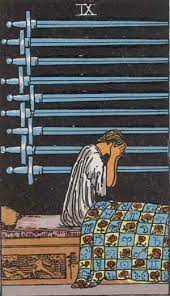
Oh, my gosh! Yolanda needs help to unlock her writer’s block! writer's block causes figure under nine swords to have a nightmareShe’s tormented by worries of failing as a writer—yet can’t get any words on the page. While she’s allowed swords of self-recrimination to stack up over her head, it’s probably not as desperate a situation as she believes.

Like many writers, Yolanda feels that if she’s stuck with her current project—short story, essay, master’s thesis—she’s “blocked.” But if she looked more closely, she might find she’s facing a more manageable problem.

In my wide experience as a writing coach, I’ve seen writers like Yolanda free themselves from the dreaded block quite quickly. They just need the right strategies.

If writer’s block is threatening, check out these common causes and their cures. You, too, may be able to unlock writer’s block and write with ease again!

Start here: Is it really a block?

At a crossroads? Maybe you’re actually just confused about what to do next. “Confusion” is not a block! It’s a reasonable response to the many paths a writer can take at any given moment. Uncertain of which way to go?

Try this: Pick any one possibility, set a timer for ten minutes, and write as if you were committed to that direction. If it’s not right, back up and try a different option.

Empty tank? Exhausted? Pushing forward when our creative tanks are empty is a sure way to grind writing to a halt. While fatigue is not necessarily a symptom of writer’s block, it sure can feel like it.

So, take note: Too tired to write? Give it a rest. Whether you need an hour or a week to recover your mojo, take it. Your restored future self will thank you.

Says who? Okay. Here’s the truth: I hate being told what to do. Maybe I’m alone in this. Maybe not. But I have noticed that when someone is writing a memoir because other people have told them to—“You’ve had such an interesting life”—the would-be writer generally loses interest at some point. Likewise with fascinating topics about which a person is an expert. Or when someone is naturally funny or a great story teller.

If you’re struggling to fulfill someone else’s literary ambitions for you, chances are good you don’t have writer’s block. You probably just don’t want to write a book. Or, at least, not the book other folks are telling you to.

Mix it up to unlock the block!

Pushing an agenda? When we come to writing with a too-tightly circumscribed agenda, we can write ourselves into a corner. Rather than trying to beat our project into obedience, we can play a bit. Free-writing on our topic can allow fresh ideas to surface, unlocking our writing progress once again.

Traveling the straight and narrow? New writers—particularly new novelists—may think their job is to start writing at the beginning and continue all the way to the end. Makes sense, right? But more often than not, this approach leaves them in a rut, wheels spinning.

Instead, imagine which scene might be the most interesting to write today. A novel is a long haul. Making it more fun makes it more likely you’ll actually get it done.

Play hopscotch! Rather than committing your focus to a single writing project, have two or three on the go. When you feel stuck with one, move to a different piece. Hopping from a stalled project to a fresher one is sure to reinvigorate your writing process.

I hope you (and Yolanda!) try unlocking your next bout of writer’s block with some of these strategies. While a little angst can make for interesting writing, I’ve found it’s best to keep most of the drama (not to mention the swords!) on the page, not hanging over our heads and  inducing nightmares.

Would you like some more writer’s (un)blocking strategies from a top writing coach?

As a professional writing coach, I’ve boosted writers at all levels of experience out of their  writing block slump. Maybe I can help you!unlock-writer's-block-with-Jamie-Morris-writing-coach Schedule your free consultation.and check out Should I Hire a Writing Coach” in THE WRITER magazine.

Thanks to U.S. Games Systems, Inc. for kind permission to use the image of the Nine of Swords from the RIDER-WAITE (SMITH) TAROT.

1 2 3 4 5 27

Copyright ©2026 Jamie Morris LLC| Contact | Privacy Policies | Terms & Conditions